Uncategorized

Falling For You Again

.

kate curranToday I’m welcoming another Kate–Kate Curran, author of the recently released Falling For You…Again. Kate started her creative journey writing fiction, but got sidetracked to a career in photojournalism, specializing in agriculture. Fifteen years later, she went back to her first love and published three children’s books. Now she has switched her talents to romance. Falling For You is her second romance novel.

Here’s Kate Curran:

************************************
Watson Falls

Watson Falls

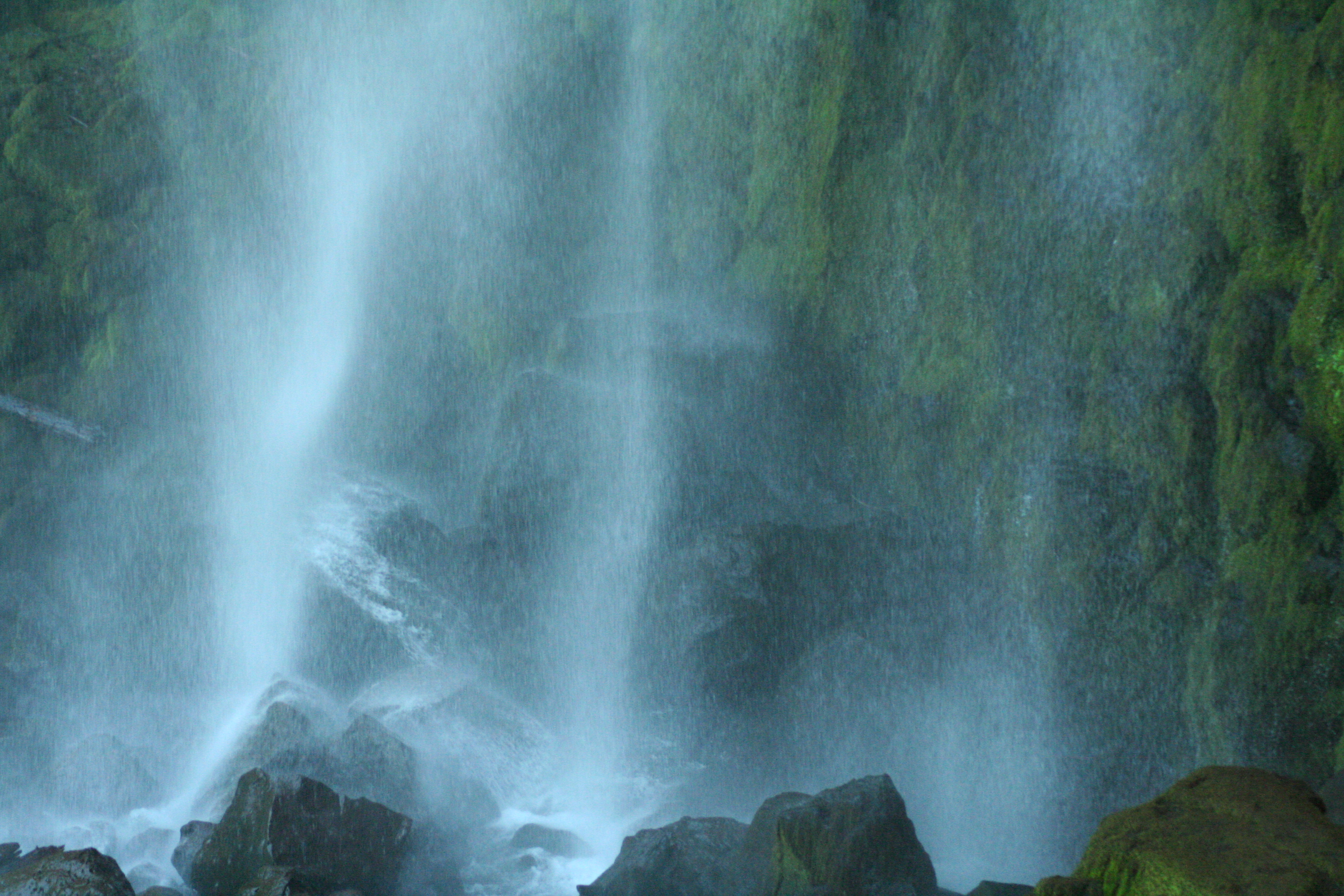
Waterfalls intrigue me. Always have always will. Their beauty and mystery draw me both as a photographer and a writer. Some of my very favorite waterfalls are in Oregon.  Highway 138 from Diamond Lake to Roseburg is referred to as the Highway of Waterfalls. (http://tinyurl.com/mvkz9cs) Watson Falls is spectacular. Toketee Falls is on my must see list. And further north, east of Portland is Multnomah Falls. Spectacular. Someday I picture a waterfall in one of my books to add intrigue and color.

My early romance reading days consisted of Kathleen Woodiwiss, LaVyrle Spencer, Joan Johnston, Nora Roberts, Susan Elizabeth Phillips and Heather Graham. These are the ladies who inspired me to write my own book

What prompted me to write a book of my own?  I’ve always got something to say J.  I would call my stories deeply emotional. I talk about family relationships, and I look for ways to resolve issues. They won’t be perfect, but my characters will learn to communicate and find better ways to resolve their issues.

My current book, Falling For You…Again is about a couple, Clare and Ethan Burke who have basically had a fairytale marriage until their 14 year-old daughter, Grace, dies in a boating accident.  Ethan almost dies in the same accident.  As the story begins two years later, Clare and Ethan are on the verge of divorce until Clare goes missing on a photo shoot.  A blizzard is eminent and they both discover their love is stronger than either of them realized.

To me this isn’t a story about death and dying, but a story of survival and that there can be happiness, and love and an engaged life after losing a child. A fan whose daughter died in her early twenties told me she wasn’t sure she could the read book, but she did. She said it didn’t bring her down, but uplifted her. And that’s what I want to give my readers. A few tears, some laughs, romance and an ending that warms their heart.

*************

.
KC-FFYA-200x300

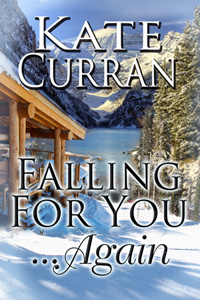
They vowed to love each other forever, then grief tore them apart.

Clare and Ethan Burke carved out a life in Paradise Falls, Idaho. While Clare built a career as an outdoor photographer, Ethan taught eighth-grade science. They raised three children and had a happily-ever-after life until tragedy struck and their daughter was killed in a boating accident.

Two years later Clare and Ethan still love each other, but their grief has pushed them to the brink of divorce. Their problems become insignificant when Clare leaves for a photo shoot into the mountains and doesn’t return. With a blizzard looming, Ethan must move heaven and earth to find her.

Will they get a second chance or lose each other forever?

.

Available on:
Amazon:  http://tinyurl.com/o4raxml
Smashwords:  https://www.smashwords.com/books/view/402961
Barnes & Noble:  http://tinyurl.com/lb5zjv3

.

Present day, Paradise Falls, Idaho…

Clare Burke bolted upright in bed.

The hazy light of dawn filtered through the French doors and sent a halo of light over the shimmering image at the foot of the bed.

“Grace.” Two years and two days since her death, and her daughter still came to her, comforted her.

Questions overrode logical thought, but rather than sort through them she blurted out the one that continually weighed on her. “Are you happy?”

Grace smiled that smile that would drive a hermit in search of companionship, then vanished.

Had she been real or imaginary? The lines were as blurred as Grace’s image.

Tears welled in Clare’s eyes, and her heart absorbed a wave of grief. Why had Grace been taken from her? Why her child? All she had left of the daughter she loved were memories. Memories of pursed lips hiding braces, purple-streaked blonde hair and the snort of teenage sarcasm.

The faint light illuminated the sky blue walls. The room should have made her think of wide open spaces, but instead it had become her prison.

She stared at the stack of self-help books on her nightstand. She knew the titles as intimately as she did herself. Learn to Grieve, Living Without Your Loved One and her more recent pick,  The Top Three Reasons Marriages Fail: Finances, Communication, and Emotional Detachment.

The knot wedged in her stomach wound tighter as she stared through a blur of tears at her husband, Ethan, sound asleep, twisted around the down comforter like a deranged pretzel.

When was the last time she’d felt truly connected to him?

Two years and two days.

They’d embraced life back then, now they tolerated it. They were shells of their former selves—colorless imitations of the vibrant couple they’d once been. Back then she would have told him about Grace’s visits. Now they were barely civil to each other. Ethan was here physically. Emotionally, he had become as untouchable as Grace.

The faint shriek of their oldest son, Jack’s, alarm filtered through the adjoining wall.

Tousled brown hair poked above the covers. A pair of matching brown eyes slowly opened and stared back at Clare.

“What time is it?”

Once upon a time that raspy voice had been her idea of a mating call. Now she felt a desperate ache that nothing filled. “Six.”

His knuckles grazed her cheek. “Still a while until we have to get up.”

Clare knew that tone, the darkening of his eyes, the wisp of a smile that had once held the promise of bliss. It would be impossibly easy to say yes, to curl into him and ignore the fact that sex for her had become as tempting as unflavored gelatin.

She pressed his hand to her cheek. “Could we just hold each other and talk instead?” Her words stripped the smile from his face.

He rolled onto his back and stared at the ceiling. “Honestly, Clare, I’m all talked out.”

“I’m not.” She desperately wanted to recapture the closeness they’d shared, and the only way she knew how to do it was by talking.

He turned his head to look at her. “You never are.”

Three simple words and their bedroom became a war zone.

**********

You can contact Kate Curran at:

http://www.katecurran.net
http://www.facebook.com/katecurranauthorpage
http://www.twitter.com/katecurrankate3
http://www.goodreads.com/KateCurran
http://www.katecurran3.blogspot.com/
Categories: Books, dealing with death, death of a child, Love, nature, outdoors, romance, survival, suspense, Uncategorized | Tags: , , , | 11 Comments

Hunting—with Horses—not Guns

.

small_210455752Man has used horses for many tasks throughout history—pulling plows, wagons and chariots, carrying loads on their backs, traveling long distances, and even hunting other animals. In fact hunting was probably one of the first uses of our equine companions. Their speed increased the chances of catching the faster prey and allowed the hunters to cover more ground. Almost everyone has seen the exciting buffalo hunt in the movie Dances With Wolves that vividly illustrated their importance to the American Plains Indians.

Riding in a hunt was dangerous and exciting. Who knew what might happen. A rider could get knocked off, a horse could trip and fall, or a prey such as a wild boar or bear could turn the tables and attack. It was a great way for warriors to hone their skills and horsemanship. As a result, hunting became a favorite pastime of the noble and wealthy.

Of course the basic purpose was to supply meat for the table or to get rid of unwanted intruders that threasmall__6465633813tened crops and livestock. One such pest was the wily fox, which found farmyard poultry easy pickings. While farmers could use dogs to track, the foxes were smart enough to backtrack and confuse their trails and lose their pursuers with relative ease. At that point a human was needed to redirect the hounds, and only someone on horseback could keep up with the chase. (Foxes can run up to thirty miles an hour.) As forests were cut down to create arable land, the number of deer decreased, causing enthusiastic hunters to switch to chasing foxes instead, particularly in Great Britain.

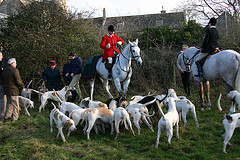
A whole culture developed around fox hunting in England, dictating what to wear, who could be part of a hunt, where you rode in the group and many other niceties. The most important member is the Master of the Hunt, who runs the whole show. He’s responsible for the care of the hounds, organizing the hunt and supervising all hired personnel. Often he also serves as the Huntsman, the one who controls the hounds during the chase. His assistants are the Whippers-In and they help make sure the hounds don’t go off chasismall_3137633691ng some other animal rather than the fox. Traditionally, male members of the hunt could wear red coats (often known as “pinks” for some unknown reason), while women wore black or navy coats with colored collars. Only members who have been “honored” by the Master are allowed to wear these colors. Everyone else wears black or navy.

While the original idea of fox hunting was a way to help eradicate a notorious pest, that rational is less valid today. In England, hunting and killing a real fox has now been outlawed. In the US, the emphasis has always been on the chase and foxes were rarely killed. Nowadays instead of pursuing real animals, most often the hounds and riders follow a scent trail laid down by someone dragging a bag smelling of fox. The “first field” of riders follows the trail exactly, going over all the obstacles. The “second field,” sometimes called Hilltoppers, takes an easier route, going through rather than over gates, and going around other obstacles, and sometimes stopping to watch the other riders from atop a hill.

Running full bore across uneven terrain, jumping ditches, hedges, streams, fences and other obstructions is a thrill that’s hard to beat. While the original rational for fox hunting may be long gone, the appeal of the chase will never fade.

****

Buffalo photo credit: http://tinyurl.com/l67cwka
Old print photo credit: http://tinyurl.com/mxc2fpx
Fox hunt photo credit:  http://tinyurl.com/m8mrjkm
Categories: dogs, fox hunting, Horses, hounds, hunting, Uncategorized | Tags: , , , , , , | 3 Comments

Sheep and Writing Stories

.

borrowed chickens.

Please welcome my guest KB Inglee. KB writes historical short stories which have appeared in several print anthologies.  Her story “Weavers Trade” placed second in Bethlehem Writers Roundtable. Many of her story ideas come from her job as historical interpreter at two living history museums near her Delaware home. And sheep are often her inspiration.

******

When I was 7 my sister was given riding lessons as a Christmas present. How can that be fair when I was the one who devoured every horse book in the library and turned our back yard apple tree into a whole stable of horses? The first story I wrote was about a horse named Star.

Imagine my surprise when I realized my first novel had not one single animal in it. It was set in a time when horses were common forms of transportation. I didn’t have so much as a cat in the kitchen.

OLYMPUS DIGITAL CAMERAIf you are going to write historicals, you need to do the things your characters do. I visited a living history museum near my home and discovered a flock of heritage sheep. I learned to give tours, tell the story of the family that lived there. My first published work (Farmer’s Daughter, Miller’s Son) is a kid’s look at the time period. I hand stitched a set of appropriate clothing. All the while I was longing to get my hands on the sheep. I wanted to do any animal type work my characters might have done: drive oxen, plow with horses, and raise chickens. I don’t remember when I was first invited to work with the sheep, probably I got to feed them when the regular shepherds were out of town. In ten years I worked myself up to head shepherd.

I was of an age where I was happy to move from 1200 pound animals with heavy feet with iron shoes to something smaller which didn’t break bones when it stood on my toes. I have been present at the birth of lambs, had had to put down old and sick animals that have been my friends for years. I can tell you how the industrial revolution changed agriculture and how the market value of sheep has changed over the years. I can process wool from the back of the sheep to the back of the person. I even butchered a sheep.

author vs sheepIf I have a muse at all, it is these animals. Like my protagonist they appear gentle but they will happily knock you down and walk over you if you are in the way. Like my protagonist they are patient and can stand around for hours waiting. If you have food, then they will push and shove to get to it, just as my protagonist will to find the answer to a problem.

If I am stuck for an idea or the way out of a plot problem, all I have to do is stand among the sheep. I can dig my fingers deep into the wool, listen to them breathe, watch them interact with each other and with me and the visitors. It may be a form of meditation.

There are still no animals in my narratives, but I have a whole flock involved in the writing.

*****

Here are some of KB’s stories, available on Amazon.

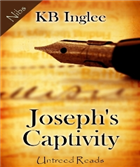
Joseph's captivity.

“Joseph’s Captivity”, Untreed Reads, 2012
A grumpy Joseph finds himself exiled, not to Egypt, but to an island
off the coast of Maine in the early colonial period.

Fish Nets.

“Netted”, Fish Nets, Wildside Press, 2013
A pile of string helps uncover a murderer

Magic Bullet.

“The Magic Bullet“, Death Knell V, Infinity Press, 2013
An article in French and an old gun provide the clues to solve a series of armed robberies.

Categories: animals, anthologies, history, living history, Mystery, outdoors, sheep, Short story, suspense, Uncategorized, writing | Tags: , , , , , | 15 Comments

Rack On!

.

Walk, trot, canter are the three basic gaits all horses have. What about slow gait, rack, running walk, single foot, tölt, fox trot, or the paso largo? These are a few of the additional gaits some breeds of horses can do. Where did all these additional gaits come from and why do they exist?

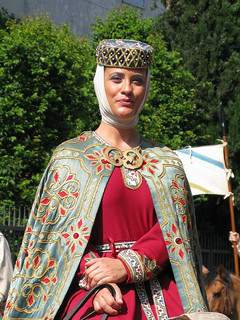
small__5787205489The simple answer is comfort. For most of human history people traveled by foot or by horse. Carts and carriages were heavy, slow and not particularly comfortable. If you wanted to get somewhere quickly, you rode horseback. However, a horse’s walk is relatively slow, the trot is uncomfortable and the canter can only be sustained for short periods. Also, it was common for women to ride sideways behind a rider, especially if they didn’t know how to ride. This put them over the most active part of the horse and restricted them to a walk. Any other gait would make it difficult to stay on.

So what was needed was a horse with a fast but smooth gait that would let you ride all day in relative ease and wouldn’t bounce you off its rump. Some horses had natural variations on the walk that allowed them to move this way. Amblers, as they were commonly known, were highly valued until about the 18th century when other forms of transportation arose.

The amble in all its permutations is a four-beat gait where at least one foot remains on the ground at all times (thanks Sue), providing a smooth, easy-to-sit ride. With three gaited horses, their backs move and require the rider to move with them. Gaited horses keep their backs relatively still and just move their legs. This provides a silky smooth ride that requires little of the rider. A classic demonstration is to have the rider carry an old fashioned, shallow glass of champagne in his hand or to put the champagne glass on the horse’s rump. A good horse won’t spill a drop.Silvano Taipe show horse

Innumerable variations of the amble developed over the centuries and in different parts of the world. Hispanic cultures tend to like flashy, showy horses and the Peruvian Paso and Paso Fino of South America reflect that. They have very fast, showy gaits that look quite unusual to American eyes. The Icelandic Pony also attracts attention for its small size and speedy ground-covering tölt.

The early settlers of the United States also valued comfortable horses and developed their own versions. The Tennessee Walking Horse, with its running walk, was bred to give plantation owners a smooth, all-day ride while they supervised their vast holdings. The Missouri Fox Trotter, Rocky Mountain Horse, Spotted Saddle Horse, and Kentucky Mountain Horse are variations on the same theme.

small_9680085853The American Saddlebred was first bred in colonial times as a high-stepping but smooth ride. Then it was further refined in Kentucky and became a popular military mount during the Civil War. Known as the peacock of the horse world, the Saddlebred can be either three-gaited or five-gaited. Its two extras are the slow gait and the rack. The rack is done at speed and is exciting and crowd pleasing. Rack on! is the command.

Here is a link to a site that has short videos of many of the horses I talked about. They need to be seen in action to be understood. http://majesticrider.com/id100.html

Since the previous site didn’t include the Saddlebred, here’s one that does. http://www.bing.com/videos/search?q=American+Saddlebred&FORM=VIRE2#view=detail&mid=1C43754AAF7CEA68E44C1C43754AAF7CEA68E44C

**********************

Lady: photo credit: <a href=”http://www.flickr.com/photos/marionzetta/5787205489/”>Marionzetta</a&gt; via <a href=”http://photopin.com”>photopin</a&gt; <a href=”http://creativecommons.org/licenses/by-nc-sa/2.0/”>cc</a&gt;
Saddlebred:  photo credit: <a href=”http://www.flickr.com/photos/desertnightcreations/9680085853/”>Heather Moreton-Abounader Photography</a> via <a href=”http://photopin.com”>photopin</a&gt; <a href=”http://creativecommons.org/licenses/by-nc/2.0/”>cc</a&gt;
Categories: gaited horses, history, Horses, Kentucky, riding, Trail riding, Uncategorized | Tags: , , | 15 Comments

Award and Going Offline

3rd.

Forewarning placed third in the Reviewers’ Choice vote for Best Mystery/Suspense, while Wyoming Escape came in fourth.

Thanks to everyone who voted!! I appreciate your support.

.

I’ll not be posting for the next two weeks. Going offline and into my writing cave. See you later.

Categories: Uncategorized | Leave a comment

The Sensitive Extrovert

Wow! WPRG Reviewer's Choice nominee flathat a surprise!

My books, WYOMING ESCAPE and FOREWARNING, have been nominated for the PRG Reviewer’s Choice Award for “Best Mystery/Thriller/Suspense.” Voting is open from through Sun, Jan 12.

I’d really appreciate your support and vote. Unfortunately the books are competing against each other, so I hope you’ll choose Forewarning. You’ll have to page down a ways to get to the Mystery/Suspense listing. If you click on either cover image, you’ll be able to see the reviews for both books.  And you need to register on the site in order to vote.
http://www.paranormalromanceguild.com/2013reviewerschoice.htm

******

I’m still catching up from the holidays, so I’m recycling an older post about horse personalities that I hope you will enjoy.

Previously I talked about the Extrovert Thinker as typified by my horse Star. Today, I’d like to discuss the Extrovert Reactor.

First, a quick note: These personality types are on a continuum, of course. Some are more extroverted than others, some are less reactive. Some can change—become less introverted or more of a thinker. But their basic type remains and influences their actions.

Portia at 29

Portia at 29

My mare Portia, a grey Anglo-Arab (half Thoroughbred and half Arabian), was a typical Extrovert Reactor. She was very sensitive to stimuli and hyper-aware of her environment. Even at age twenty-nine and retired, she could be a challenge and needed an experienced handler. Not that she’d ever deliberately hurt someone, she just tended to react first and think later.

She also really enjoyed life. She loved to play and would try her best to please. She’d yell a greeting when she saw me and come running up to the gate eager for a treat or an outing. In the show ring or a parade, when she “turned on” all eyes were on her. She also used to fly down a new trail with her incredible walk, eager to see what was around the next corner. Even though she could be a pain in the butt, her exuberance was a lot of fun.

When I first got her as a seven year-old, she was ready to spin and bolt at the slightest provocation—a rock that looked funny, a horse scratching it’s ear with a hind leg, a COW on the trail! She soon learned bolting wasn’t acceptable behavior so she tried others. Like teleporting half way across the arena or jittering in place or jumping straight up. I eventually discovered that part of the reason for her reactivity was because she was in pain. She needed chiropractic care (just starting with horses at that time and not widely accepted) and a correctly fitted saddle (which proved to be almost impossible to find). Once those problems were solved, she settled down a lot.

But she still retained her quirky personality. One time we hung a bright pink piñata in a tree near the pasture and she and my daughter’s horse decided that it was a decidedly SCARY thing. They came up close to the fence, took a look, then snorted and high-tailed it back to the barn. Duchess stayed there, but Portia couldn’t resist. She’d dance back up to the fence and watch big-eyed as one of kids swung at the colorful unicorn. Then she’d take off for the other end. A few minutes later, she was back, waiting to be “scared” again. I swear she was disappointed when the thing finally broke and everyone went away.

Her playfulness and sensitivity made her a delight to train. She was eager to learn new things and would try her hardest to do what I asked. Of course, this meant I had to be quite careful  with my corrections so I wouldn’t discourage her. In general, she’s always required a very light hand. As a result, I got a horse responsive to the slightest cue and that just about read my mind.

Riding her was never dull. One time we were exploring in the mountains and I twisted around in the saddle to get a map out of the saddlebag behind me. Just then a pair of fawns exploded across the trail, directly in front of us. Portia spun aside–out from under me because of the way I was turned. I ended up hanging off her, one hand somehow on her bridle, one hand on the breast collar, one foot still in a stirrup under her belly and the other still in the stirrup on top of her back. Because of how far down I was and the fact the saddle was slipping, I couldn’t get back up. Another horse might have freaked and tried to get rid of me, but Portia stood perfectly still and waited for me to work myself loose of the stirrups and drop to the ground. I really couldn’t blame her for dodging  the fawns and I certainly appreciated her being sensible.

Obviously a sensitive, reactive personality is not appropriate for an inexperienced horse person. This type needs a calm, confident rider who doesn’t get upset by spooks and silliness. But if you know what you are doing and have a light touch, a extrovert-reactor can be great fun.

I lost Portia this summer at age 30. I really miss my delightful “brat child.”

Categories: Books, horse personalities, Horses, nature, outdoors, riding, training horses, Uncategorized | Tags: , , , , , | 3 Comments

A Flight of Marewings

marewings-tour-banner Welcome back everyone. Hope you had a great holiday season. Today my guest blogger Kristen Walker talks about how she learned about horses so she could write about them for her novel A Flight of Marewings.

Fantasy author Kristen S. Walker dreams of being a pirate mermaid who can talk to sharks, but she settles for writing stories for teens and adults. Her new novel, A Flight of Marewings, tells the adventure of a duke’s illegitimate daughter who must stop her father’s murderers–by taming a dangerous monster. A Flight of Marewings is now available in print from Amazon and digitally from Amazon, Barnes & Noble, Smashwords and other ebook retailers.

******

Writing About Horses Secondhand

When I was a little girl, I loved horses better than anything else. I read every book at the library with a horse on the cover, from Black Beauty to The Red Pony. I collected horse figures and put up posters of horses on my walls. I begged and begged my parents for riding lessons. But my parents said no to riding both for financial and safety reasons, and I had to content myself with looking at horses from afar. Now fast forward a few decades to today and my passion for horses hasn’t really diminished, but I find myself with almost no firsthand experiences with horses.

So writing a book about horses would be crazy, right? I must be crazy, because I was determined not to let my personal lack of knowledge stand in my way. I knew that I wanted to write about marewings (my magical half-horse, half-demon creatures) in a way that would be instantly recognizable to anyone who knew horses. I had to find a way to fake it. Here’s how I did it.

1. Academic research Before the internet, I checked out books at the library. Today, information on everything from grooming to breeding to training horses is only a Google search away. I knew that I had to double-check my facts, because the fictional horses I’d read about could be the products of artistic license or author ignorance. (Fantasy novels are known for a phenomenon called the “motorcycle horse”, where the hero rides all over the fantasy map without stopping to take care of or feed his poor horse–treating them just like a convenient motorcycle!) While I couldn’t find real world information about winged horses, I wanted to base my marewings’ behavior on real horses as close as I could. Accounts of catching and taming wild horses were very important, because catching a marewing is a focal point of my novel.

2. Talking to experienced riders Again, the internet came in handy here, because I don’t know many horse riders personally. But online, there are experienced riders who were happy to answer my questions. And I really loved finding blogs where owners and riders talk about their daily experiences with their horses. They’re full of anecdotes and insights that can only come from hands-on time. Without stories of my own, I could read the stories of others. These were huge for illustrating the special bond between a horse and rider that have worked together for a long time.

3. Watching Horses When I was younger, I used to walk to the bus stop for school, and I passed a paddock with an old gray gelding named Sunny. I could spend hours standing there just watching him. I’ve also been to visit horse ranches and watch other riders work with their horses. There are also great documentaries, and even videos on YouTube that show horse behavior. (Not Hollywood movies, though, because those can be just as wrong as books!) Nothing substitutes for real experience, but we can’t always try everything that we want to write about. The internet makes research easier. And even when you have some experience, it doesn’t hurt to check for things you may not know. And maybe someday I will have the chance to get to know a horse a little better, and write about the experience. I look forward to that day.

*******

marewings-cover-sm .

Korinna’s life gets turned upside down when the ghost of her father suddenly appears. Her father was duke of Kyratia City and he wanted Korinna to marry his warlord, the foreign mercenary Galenos, and inherit his title–but the city’s Council has other plans. When the Council denies Korinna’s right to rule, she decides to join Galenos’s mercenary company and tame a wild marewing in order to take the city by force. But people whisper that the late duke’s untimely death was murder, an induced madness that forced him to dance himself to death–and now that madness is spreading. Can Korinna become a marewing rider and conquer Kyratia in time to save everyone?

.

.

Available at:  http://www.amazon.com/B00HMTRAJQ/ and other eBook retailers

*******

To read a sample chapter or check out Kristen’s pirate pictures, please visit kristenwalker.net.

You can talk good books, cats, or medieval cooking with Kristen anytime on Twitter (@KristenSWalker) or Facebook.

Categories: blog hops, Books, fantasy, Horses, Love, Paranormal, suspense, Uncategorized | Tags: , , , , | 10 Comments

Happy New Year!!

small_5311502880Happy New Year Everyone!
Wishing you a wonderful 2014.


My regular blog will resume next week. Be sure to stop by and catch my guest bloggers and for horse info.

Thanks so much reading.

.

photo credit: <a href=”http://www.flickr.com/photos/rk_photos/5311502880/”>raghavvidya</a&gt; via <a href=”http://photopin.com”>photopin</a&gt; <a href=”http://creativecommons.org/licenses/by-nc-nd/2.0/”>cc</a&gt;
Categories: Uncategorized | 1 Comment

99¢ E-BOOK SALE

99 book sale

Check out the awesome books–including Wyoming Escape!

.

If you enjoy eBooks, over 60 authors have come together to offer their books for .99 for four days only. Get ’em while you can.

.

http://99kindle.blogspot.com/

Categories: Books, Christmas, Mystery, Paranormal, Romantic suspense, suspense, Uncategorized | Tags: , , , , , , , , | 2 Comments

In the Saddle: Regency Riding

.

Interesting article on riding sidesaddle and earlier styles of riding. I’ll let this take the place of the blog I had intended to do because the info is really good.

 .

This will be my last blog of the year. I’m going to take time off for the holidays and will resume blogging in the new year. Don’t forget my two Christmas promos.

 .

The Winter Wonderland Scavenger Hunt. http://tinyurl.com/n85tvtn

Win author baskets and discover new books.

.

Indie Tribe Special Christmas Showcase. http://tinyurl.com/nxyqbxn

Lots of fun authors and books.


SD Writer's avatarShannon Donnelly's Fresh Ink

foxhunting The horse was a vital part of everyday Regency life, but few of us today have such an intimate acquaintance with that lovely animal.  We all know how to describe someone getting in and out of a car, but what about getting on and off a horse?  What does it actually feel like to ride side saddle?  How can two people ride a single horse?

The English saddle has changed little in its appearance over the past two hundred years.  The major change came at the end of the 19th century when the modern “Forward Seat: was invented and the saddle flap began to be cut “forward” so that it lay over a horse’s shoulder (allowing a shorter stirrup).  Prior to this, riders sat very straight in the saddle, leaning back when jumping fences, as seen in hunting prints of the era.

The Side Saddle

sidesaddle1790-1810Prior to 1835, a side…

View original post 2,370 more words

Categories: history, Horses, nature, outdoors, riding, Thoroughbreds, Uncategorized | Tags: , , , | 4 Comments

Blog at WordPress.com.