Horses

A Horse by Any Other Name

.

Robin WeaverMy guest this week is Robin Weaver and she’ll be talking about a most unusual sort of horse. She’s a professional computer geek who started writing extensively when she traded in her ski boots for flip-flops and moved to North Carolina. When she’s not writing, you can find her with her toes in the sand or appreciating nature in the Blue Ridge Mountains. Her novels, Blue Ridge Fear, and Artifact of Death, are currently available via Amazon, Barnes and Noble, and the Wild Rose Press.

She also writes paranormal romance under the alias Genia Avers and her novel FORBIDDEN MAGIC was a 2013 PRISM finalist. A Golden Heart finalist and winner of the prestigious Daphne du Maurier contest, she has one constant: a HEA.

**********************************

Carousel horseOriginally, Forbidden Magic was a story about vampires—vampires living on a planet without homeotherms (warm-blooded creatures). I wrote the manuscript when vamps were hot, thinking I’d given the old Dracula story a unique twist. Not so much. By the time my manuscript made it to an interested publisher, all the life had been sucked out of vampire books.

Still, the editor liked my concept and asked if I could change my characters to another life form. “Sure. No problem,” I said, making the sign of the cross.

Stop laughing. J

I needed a dozen or so crosses and even more wooden stakes (and lots of wine), but I managed to convert the vamps into álfar and Dökkálfar (light and dark elves) without sacrificing my characters or plot. What I didn’t have to change were my equestors.

“E-what?” you ask. The original (and final) version of Forbidden Magic had a medieval feel. You can’t write that period without including a non-mechanical form of transportation, i.e., horse-drawn carriages. Unfortunately, with no warm-blooded animals on the planet, I had a problem.

So I did what Houston would do—I built a horse. I envisioned a cross between a flexible carousel horse and R2-D2. In the book, I purposely left descriptions of my hybrid horses vague. I wanted readers to create their own unique images of the magnificent beasts.

Naturally I couldn’t call these non-horses horses. My first pass at naming the animals was Equinators—but that sounded too much like something involving a roto-rooter, so I kept the root of the word, “Eq” and combined it with adventurers. With a little tweaking, the EQUESTOR was born.

I try to make my heroines very different from the author (me), i.e., not “younger and improved” versions of myself. However, in Forbidden Magic, Subena shares my love of horses.

He’d heard she was an excellent rider but doubted the poor creatures he’d seen in the Mydrian stables could even manage a trot. Maybe if he let her ride a real equestor, Subena would thaw a bit. Hell, he’d give her his steed if she’d smile at him like that.

And once I created the beast, I had a lot of fun with the word:

“You…you…equestor’s ass.”

Still, I tried to keep the hybrid as close to the real animal as possible, even hinting the equestor might be descended from a “real horse.”

Arkton grinned. “There’ve been animals here as long as I can remember. Legend has it Rothart’s grandfather bred one of the local mares with a real horse, brought from earth to this planet.”

Subena suppressed a smile. Gatslians had a legend for everything—there was no such thing as a horse.

Creating the equestor was one of the most enjoyable parts of my novel-completion process. Writing is hard work, so if you have the opportunity, have some fun and create your own equestor. J

Happy writing!

Robin Weaver (a.k.a. Genia Avers)

************************

Forbidden MaagicFORBIDDEN MAGIC is the first novel in a series of romantic adventures chronicling the intercultural challenges as Mydrias and Gastle attempt to resolve their differences and return to earth.

Subena’s people are dying. To obtain the crystals the álfar need to survive, she agrees to a treaty with the hated Gatslians. King Rothart has but one demand—she must wed his son, Prince Kamber. Subena vows the marriage will be in name only, but she is ill prepared for an attraction stronger than the ancient magic lying dormant in the land. Add to the chaotic mix a former suitor, a phantom lover, attempted murder, and an invasion by hostile troops, and Subena’s world isn’t what it used to be. Ancient skills might shield her body, but she possesses no power to protect her heart. Can she fight his former paramour and keep the seductress from laying claim to the man who’s made his imprint on Subena’s soul? Or is love as much of an illusion as a return to the planet Earth?

http://www.amazon.com/Forbidden-Magic-Lanatus-Chronicles-Series-ebook/dp/B0085XCJAS/

http://www.barnesandnoble.com/w/forbidden-magic-genia-avers/

.

 

Forbidden Flamehttp://www.amazon.com/Forbidden-Flame-The-Lanatus-Chronicles-ebook/dp/B00CJEIJOY/

http://www.barnesandnoble.com/w/forbidden-flame-genia-avers/1115184686?ean=2940016433738


Forbidden Twicehttp://www.amazon.com/Forbidden-Twice-The-Lanatus-Chronicles-ebook/dp/B00IT5IZWI/

http://www.barnesandnoble.com/w/forbidden-twice-genia-avers/1118724491?ean=2940149190430

Categories: Books, elves, fantasy, Horses, Paranormal, paranormal romance, romance, Uncategorized | Tags: , , , , , , | 8 Comments

The Language of Horses

.

In contradiction to what we often see in movies and on TV, horses do not constantly make noise. They don’t whinny every time someone rides them, nor do they “scream” if they are hit by a whip (as one misguided author wrote). As prey animals, they tend to be quiet, not wanting to attract attention. They do, however, have very effective communication, using both vocalizations and body language.

small_2645376508A mare talking to her foal uses a low, soft whicker to show affection. She greets a friend, of any species, with a slightly louder, rumbling nicker or, if she’s excited, a higher pitched whinny. If you walk into a barn at feeding time, you’ll probably be barraged by both loud and soft greetings, according to the different personalities and how hungry they are.

Squeals are also a common way that horses communicate. When horses meet for the first time, they sniff noses, sometimes getting quite noisy about it, then often they’ll squeal and strike out with a front foot—a dominance behavior. Mares in season tend to squeal a lot too, usually adding a slight, threatening kick to tell others to keep away. The squeal and kick also say “stay away from my food!” My mare Glory has to assert herself this way whenever the gelding in the next stall looks at her while she’s eating her grain. You’ll also hear squeals as an expression of high spirits and playfulness.

Horses are herd animals and bond very strongly. If they are separated from one of their friends they’ll often neigh repeatedly, calling to them. If another horse answers, it may start a “conversation” that doesn’t end until the looked-for horse returns. Since a neigh is a high-pitched vibrating sound that can be quite loud, this can get old very quickly. My Portia had a bellow that could hurt your ears.

About the only time you might actually hear a horse scream is when a stallion is challenging a rival. A fight is a noisy affair.

small__6087150424The one sound you don’t ever want to hear from your horse is a groan. Horses tend to be quite stoic and tolerate a lot of pain. By the time they hurt enough to groan, they usually are in big trouble and you’d better get the vet out ASAP. The groan associated with colic is one of the scariest a horse owner can hear. However, the hurting groan is different from the grunt and groan you often hear when they roll. That’s just a “oh that feels so good” sound.

I had originally intended to talk about body language too, but that would make this post too long. I’ll save it for next time.

So the next time you see a movie where the horse whinnies as it does something, you can shake your head and mutter “Hollywood.” What silly things have you seen horses do on screen? Or have read about in a book?

*******************

Mare and foal: photo credit: <a href=”http://www.flickr.com/photos/nomanson/2645376508/”>nomanson</a&gt; via <a href=”http://photopin.com”>photopin</a&gt; <a href=”http://creativecommons.org/licenses/by-nc/2.0/”>cc</a&gt
 
Photo: photo credit: <a href=”http://www.flickr.com/photos/55839122@N04/6087150424/”>NatureNerd (probably outside)</a> via <a href=”http://photopin.com”>photopin</a&gt; <a href=”http://creativecommons.org/licenses/by-nc/2.0/”>cc</a&gt;
Categories: animals, horse care, horse personalities, Horses, How horses talk, Mother Nature, outdoors, riding, Uncategorized | Tags: , , , , | 24 Comments

Kentucky Horse Park

Kentucky Horse park.

Last month, guest Kathryn Jane told us interesting facts about the Kentucky Derby. This week I’d like to talk about the Kentucky Horse Park, a unique facility celebrating America’s horses.

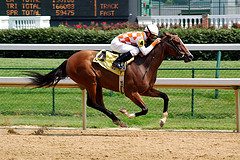
Located in Lexington, the home of the Kentucky Derby, the Park is a tribute to the racing Thoroughbred. A huge statue of Man of War stands over his grave in a courtyard near the entrance. On the path leading up to the memorial are markers showing the stride length of a few of the most famous Thoroughbreds of all time. The distance that Secretariat covered in one leap vividly demonstrates why he is still the fastest horse ever. All throughout the park you will find statues and graves of many famous racers and other tributes to the state’s most important industry. In addition, at the Haman of warll of Champions you can see retired Thoroughbred, Standardbred and Quarter Horse racing champions exhibited daily.

The Park was designed as a living museum dedicated to all horses, not just Thoroughbreds. One of its most fascinating features is the International Museum of the Horse, the world’s largest museum chronicling the history of the horse and its importance to man. Associated with the Smithsonian, the IMH uses its 60,000 feet to educate the public about the horse’s unique contributions to human history. As you walk up a long, winding ramp you follow the development of the horse and its various roles throughout time. Also there are interactive exhibits about the Arabian horse, the Kentucky Thoroughbred, Draft horses, Horse Shows, the famous Buffalo Soldiers, and horse-drawn vehicles. In addition to the IMH, there are the American Saddlebred museum and the Wheeler museum, which details all aspects of the hunter/jumper world.

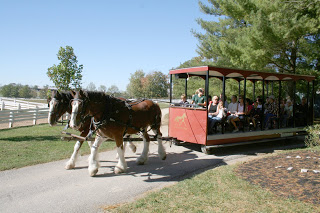
KHP tourOne of the most popular attractions is the Horses of the World. Over thirty different breeds live in the Park and are featured in daily shows or tours. Many unique horses with costumed riders are presented and after the shows visitors can meet and pet their favorites. In addition there are horse drawn tours and carriage rides, horseback riding and pony rides, and in the Spring mares and foals to visit.

If you are at all into horses and end up near Lexington, you should try to visit the Kentucky Horse Park. It’s a fascinating and totally unique experience that the whole family should enjoy—especially any horse crazy female members.

************

Photo Kentucky Horse Park courtesy of http://www.flickr.com/photos/rbglasson/3742826141
Photo Mar of War Memorial courtesy of http://www.fotopedia.com/items/kweaver2-JCMfVLC4B
Photo Horse Drawn Tour courtesy of myoldkentucky.blogspot.com/2007/10/kentucky-h
 
Categories: Horses, International Museum of the Horse, Kentucky, Kentucky Derby, Kentucky Horse Park, nature, outdoors, Racing, Show jumping, stables, Thoroughbreds, Uncategorized | Tags: , , , | 14 Comments

Kentucky Derby Facts

DSC_0066

.

May is coming soon  and with it the Kentucky Derby. Today author Kathryn Jane, a race horse trainer, tells us some interesting facts about the Derby and its traditions.

******************
With the approach of the first Saturday in May, better known in my circles as Kentucky Derby day, I thought I’d share six  interesting facts for writers and everyone else.

.
When including the Derby in your writing, there are a some things that really shouldn’t involve artistic license so I’ll save you the embarrassment with a few details that may help you with your work, and those of you who aren’t writers will have a tidbit of knowledge to impress your family and friends as you settle in front of the television on May 3rd to watch the 140th Kentucky Derby.

.
Fact 1
The Kentucky Derby has been tagged as the “Greatest Two Minutes in Sports” because the journey begins before a horse is born, takes years of preparation to get to the race itself, and then the whole thing is over in about two minutes.

.
Fact 2
The Derby is exclusively for Thoroughbreds in their three year old year. This year, all entrants will be foals of2011, and because Thoroughbreds are typically born between January 01st and May 31st, most of the horses competing will be literally, three years old. (Officially, Thoroughbreds are all considered to have the same birthday, January 1st.)

.
Fact 3
The field will be made up of mostly colts. That is, unaltered (unneutered) males. Geldings and fillies are allowed to compete in the race, but fillies usually run in the Kentucky Oaks instead, a race restricted to three year old fillies. There have only been three fillies and nine geldings to win the Derby. Colts and geldings carry 126 lbs, and fillies carry 121lbs

.
Fact 4
The Derby is run on a dirt racetrack, never on turf. (Turf is a grass track and a much different surface for horses to run on. Horses are very rarely successful on both surfaces as the two require different types of conformation and running style. It is not unusual for a well-bred horse that has been a racing disappointment on dirt to be switched to turf and show amazing talent.)

.
Fact 5
Approximately 400 foals will be nominated each year, and no more than 20 of those will be allowed to compete in the Derby when they turn three. Entry eligibility is based on money earned.

.
Fact 6
The race is a mile and a quarter, is run counter clockwise (as are all US horse races), and has never been run in less than one minute and fifty-nine seconds. Secretariat still holds the record for the fastest win at 1:59:4

.
It’s been fun to stop by and I’ll stay posted for any questions you’d like to ask

*********************

DaringToLove(2) final coverDaring to Love

A woman who reads hearts…
“Help me…” As an empath working for an organization dedicated to locating missing children, Liz MacKenzie is accustomed to using her unique abilities to sense the emotions of others. She’s not accustomed to hearing them call for her. That’s the specialized skill of a telepath.

.
A man who reads minds…

Galen Keifer’s special method of interrogation involves telepathic seduction, a technique that drove away the love of his life two years ago. In spite of their rocky past, Liz has reached out to him again. He’s the one man who may be able to discover the truth about the mysterious voice calling to her.

.
A voice from the darkness…

Liz can’t ignore the child’s voice, one that may be connected to a dark secret in her past. Barely recovered from her last rescue mission, she doesn’t trust her own senses, or a man who uses seduction in such a devastating way. But with the possibility of a child’s life in danger, Liz and Galen can’t afford to let it get personal again. Finding the child comes first, even though their hearts and minds are daring them to love…

.

THE INTREPID WOMEN SERIES
Stubborn, self-sufficient women, and the men who dare to love them.

***************

You can find out more about Kathryn at:

Kindle : http://www.amazon.com/dp/B00I13NB9U
Print: http://bit.ly/1d8Wq0w
Website: http://kathrynjane.com/
Facebook: http://www.facebook.com/kathryn.jane.921
Twitter: @Author_Kat_Jane


Categories: Horses, Kentucky, Kentucky Derby, Racing, riding, Thoroughbreds, Uncategorized | Tags: , , , , | 16 Comments

Jumping For Fun or Ribbons

.medium_515302767

Horses are good at jumping things. It was necessary for their survival in the wild. People love to ride horses over jumps. In the past it was a fun as well as useful skill. If you were running at speed chasing prey to eat or perhaps charging in a battle, the ground was unlikely to be perfectly level and you and your horse needed to be able to handle ditches, streams and other obstacles.

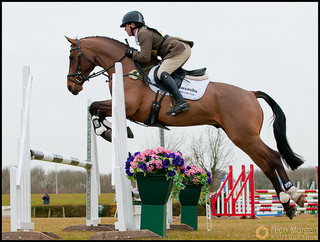
Today, of course, we don’t have to face those challenges. Instead we ride and jump for the fun of it. Some people ride cross-country in Three-Day Events (see Not For The Faint of Heart) or follow a Hunt (see Hunting—With Horses–Not Guns). But most people ride in a ring and jump over artificial obstacles or fences. For those who like to compete there are horse shows with jumping classes.

Horse show jumping is divided into two separate disciplines—Hunters and Jumpers.

small__4458883343Hunter classes focus on the ease and style of the horse and rider as they go over jumps that are similar to what they might face on a hunt field. Hunters move with long, low, ground-covering strides and are very calm and collected. The rider almost looks like a passenger with the horse just casually floating over the fences. But the hunter must have perfect form as it jumps—knees up and forelegs parallel to the ground, legs even and tucked, and a graceful bascule (curved shaped). Style is all important. Besides way of going, this also includes appropriate tack (saddle, bridle, and martingale), braided manes and sometimes tails too, polished hooves, and the rider in conservative attire.

Hunter video:  http://www.youtube.com/watch?v=cgXm9eR0lb0

There are different tysmall__4630636060pes of hunter classes and a couple don’t include fences. Flat classes, often called hunter under saddle or hunter hack, are judged on the horse’s gaits, way of going and suitability. In-hand or model classes judge the horse’s conformation and gaits. In these the horse is led and has no saddle.

Jumper classes are very different from hunters. The focus is on clearing the jumps in the time allotted. Style, looks, attitude—none of that matters. In a hunter class, your horse may clear all the jumps but unless he does it in an easy, stylish manner with exactly the right striding and take off, he may still not score well. It depends on the subjective evaluation of the judge(s). In a jumping class, numbers tell the story. How many jumps cleared, how many faults from refusals or knockdowns, how many time faults—these are what determine the results.

small__9633348424Instead of natural looking jumps, jumpers are faced with colorful and sometimes quite outlandish obstacles, which can be scary or confusing for the horses but fun for the audience. You can see some of the most dramatic at the Olympics. Not only are the courses unusual, they are also more difficult and technical. These require bold, powerful, fast horses that are also accurate and balanced. Faced with a high fence a horse naturally speeds up. In contrast to the relaxed, laid back hunters, jumpers charge their jumps and often look barely under control. In speed classes, the audience often has their hearts in their throats.

Jumping video: http://www.youtube.com/watch?v=osAgyQtXWto

If you have the chance, go to a horse show that features hunters and/or jumpers. You’ll see some marvelously skilled athletes and have a great time.

************

High jump:  photo credit: <a href=”http://www.flickr.com/photos/thowra/515302767/”>Thowra_uk</a&gt; via <a href=”http://photopin.com”>photopin</a&gt; <a href=”http://creativecommons.org/licenses/by/2.0/”>cc</a&gt;
Hunter photo credit: <a href=”http://www.flickr.com/photos/nico/4458883343/”>Nico&#8230;.</a> via <a href=”http://photopin.com”>photopin</a&gt; <a href=”http://creativecommons.org/licenses/by-nc-nd/2.0/”>cc</a&gt;
In hand:  photo credit: <a href=”http://www.flickr.com/photos/fivefurlongs/4630636060/”>Five Furlongs</a> via <a href=”http://photopin.com”>photopin</a&gt; <a href=”http://creativecommons.org/licenses/by-nd/2.0/”>cc</a&gt;
Zebras:  photo credit: <a href=”http://www.flickr.com/photos/rpmarks/9633348424/”>R~P~M</a&gt; via <a href=”http://photopin.com”>photopin</a&gt; <a href=”http://creativecommons.org/licenses/by-nc-nd/2.0/”>cc</a&gt;
 

Categories: animals, Horses, hunting, Jumping, Olympics, ponies, riding, Show jumping, Thoroughbreds, Uncategorized | Tags: , , , | 7 Comments

My Therapist Barks

.

GenieGabrielPhoto600Today my guest is Genene Valleau, writing as Genie Gabriel. Genie is an optimist whose rose-colored glasses have bent frames and cracked lenses. She writes about people who find courage and integrity in the darkest times of their lives, who rescue stray dogs and kittens, who find a person they would willingly give their lives for, and who make their little corners of the world a better place.

FREE BOOKS!
Genene is offering a free PDF copy of her most recent book, St. Batsy and the Time Machine, to 5 commenters!

******

Raz150x174Love unconditionally. Dream big. Play with great seriousness. Bark at strangers and skateboards.

These are some of the lessons my dogs have come to teach me. I’m working on the first three, but think I’ll leave the barking to my herd of doggies.

Fur against my face and the soft smell of a dog curled protectively around me existed before my first memories of this life. My mom used to tell stories of me as a toddler, sleeping with my head pillowed on our Collie’s belly.

I grew up on a farm, and we always had a dog. I wanted a horse too, but was in high school before my dad gave in to my begging to have one. Do you think you can become addicted to the smell of a horse? To this day, even the memory of that sweet aroma totally relaxes me.

However, after graduation, I moved to the city to claim a job and my own life. A back yard isn’t the best place for a horse, but I could indulge my love for dogs. A small, mixed breed Lady became the first beloved companion in my adult life. She tried to teach me to choose my relationships wisely. Ah, if only I had listened to her. An ill-fitting marriage ending in divorce turned my focus back to dogs as companions.

Batman150x194I was almost forty years old when I discovered the joy of shelter dogs and living with more than one canine. The more time I spent with dogs, the more I learned.

When I began writing, dogs naturally turned up in my stories. My first novel, published as The Rock Star, featured a dog who turns on the coffee maker for his mistress and has an attitude similar to my first shelter dog, a Border Collie mix.

Two of my romantic comedy novellas also feature dogs inspired by canines who have shared my life. My latest book to be released in print, St. Batzy & the Time Machine, features a terrier with a penchant for misadventures. His attitude is quite similar to my own terrier, who views fences as something to try to dig under, jump over, or wiggle through.

Dogs will definitely continue to be strong characters in my writing. In fact, I will soon be publishing a book about my journey with dogs and how they have guided me through traumas and brought me face to face with sometimes uncomfortable truths. However, underlying all their actions is pure, unconditional love and the support to make our most precious dreams a reality.

Oh yes, and to play–no barking needed on my part!

*****************

StBatzyCoverFront200An eccentric inventor is determined to reclaim his wayward time machine and save his beloved wife from her latest misadventure. If only they can travel safely past the black hole…
 

******************

When they were seated, he told Dorinda the story of how he and Maddie had met. How he loved her from the first moment, and never thought a woman as bold and brave would ever love him in return. “My Maddie still goes on grand adventures to change the world. I worry about her, but I’m so proud of her.”

Dorinda remained quiet for a few moments after Horace stopped talking, then said softly. “I would like to live in a world where there is plenty of food and women are allowed to follow their passions.”

In the next breath, she pushed out a sigh and stood. “’It is not productive to grumble about what cannot be. I will leave you to rest, and I have much to think about. Thank you for a look into the future. You have given me hope.”

“Let me accompany you back to the village.” Horace also rose.

However, Dorinda shook her head. “As an elfenchaun, I’ll be quite safe with the creatures of the forest.”

Still, Horace watched Dorinda from the entryway of the time machine until the trail of shimmering green faded into the night. Elfenchaun or not, he worried about the delicate creature who had shown him such kindness. Would she truly be forced to give up the life of relative freedom she had known and marry a man who would control her every move? He would not want to smother his Maddie’s bold spirit, even if it cost him days of worry when she was gone.

All the next day, Horace toiled under the watchful eye of Dorinda’s grandfather. As the light of day faded into twilight, the man shook Horace’s hand and presented him with a curved piece of metal to repair the time machine.

Though exhaustion threatened, the desire to return to the year 2011 and rescue his Maddie gave Horace the energy to drag the metal back through the forest and replace the damaged panel of the time machine.

As Horace gathered his tools and placed them back inside the time machine, he looked forward to seeing Maddie again. He walked the short distance to a small stream and splashed cool water over his face, any tiredness dripping away with the water that ran down his skin. Soon he would see his Maddie!

The short distance back to the time machine took only a few moments, yet Horace knew something was not as he left it. His steps slowed and he looked cautiously around, listening carefully for any clue to what might have happened in the moments he had been gone.

A moan near his feet was all that prevented him from stepping on a tiny crumpled body on the ground. “Dorinda?”

He bent over the little elfenchaun, stunned by the pallor of her face and the broken remnants of her iridescent wings. “What happened?”

“Over here! I saw her fly this way.” Strident shouts tore the peace of the night to tatters as lanterns bobbed closer and closer.

Adrenaline surged through Horace. As carefully as possible, he lifted Dorinda and carried her into the time machine. Laying her on a pad next to Batzy, Horace locked the door panel and started the sequence for the reactor. “Clement, can you give us a boost to get us out of here?”

“Thank the heavens!” Maddie appeared on the monitor beside Horace’s cousin.

Clement’s fingers flew over the computer keyboard. “What took you so long to make repairs?”

************

Print version of St. Batzy plus Genie’s other books on:  http://tinyurl.com/mozwtzd

ebook version of St. Batzy also available at Rogue Phoenix Press:  http://tinyurl.com/mwzuj4v

Categories: animals, dogs, healing, Horses, Paranormal, Relationships, romance, Romantic suspense, suspense, Time travel, Uncategorized | Tags: , , , , | 13 Comments

I is for Horse Illnesses

.

small_185495090For such large, athletic animals domestic horses are surprisingly fragile, due to the artificial environment man puts them in. Wild horses are sturdy, hardy animals—smart, wily and able to take care of themselves. They graze all day, move constantly and only the healthiest survive and reproduce. They are also relatively small, not particularly pretty and very strong-willed.

Consequently, when man decided horses were good for more than providing meat and milk, he began breeding them for specific traits. Good temperament, large size, speed and beauty were some of the prized characteristics. Over the millennia horses morphed into creatures that often would have a hard time surviving in the wild and even have problems surviving in man’s care. The desire to win races has resulted in many Thoroughbreds being very fast but having weak feet and overly sensitive emotions. Show ring “fashions” have encouraged huge bodies with slim, tiny legs and feet that cannot stay sound for the long run. And, of course, miniature horses, as cute as they are, would be hard pressed to survive on their own.

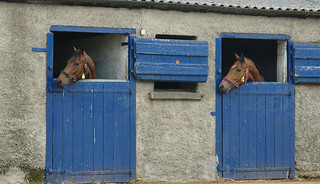
small__598978125Add to that, being confined twenty-three hours a day in a small stall, being fed large amounts of hay, instead of eating grass, and being asked to do intense work instead of moving casually, and today’s horses develop problems that they wouldn’t encounter in the wild.

One of the most common and deadly problems is a result of how they are kept and fed. The horse’s stomach is designed to digest small portions of food all day long. While some horses are kept in large pastures where they can graze naturally, this kind of open land is disappearing and most horses, by necessity, live in confined areas, either stalls or paddocks. Then they are fed calorie-dense hay and often grain too, usually twice a day because that fits best with human schedules. As a result their digestive systems can be easily upset and they can colic.

Colic is basically a painful bellyache that can be relatively easy to treat or can develop into something deadly. It is the most common cause of death in horses. Bad food, dirty water, parasites, lack of exercise, a sudden change in the weather are some of the many things that can provoke a colic attack. In most cases, the problem can be solved by a visit from the vet. Sometimes surgery is required (a very expensive proposition) and other times the only thing to do is to put the suffering animal down. Good management is vital to keeping horses healthy and happy.

freeimage-144227Another illness connected to food and care is known as laminitis, a very painful condition that affects the hooves. The equine digestive system cannot handle large amounts of concentrated, high-carb food. If a horse should get loose and into the grain barrel or pig out on high-sugar Spring grass, this can trigger an inflammatory response which destroys the tissues in its hooves that hold the boney structures in place. Depending on the extent of the damage, the result can be devastating. Conditions such as Cushings Disease or Metabolic Syndrome can make horses susceptible to laminitis problems too.

As odd as it might seem, horses have many of the same problems that humans do. They can have allergies, COPD, arthritis, thyroid dysfunctions, bursitis and a host of other disorders. And they are treated with many of the same medicines. I used to give my daughter’s mare powdered Synthroid for her low thyroid and albuterol for her breathing problems. Horses with stomach ulcers often get Tagamet.

Of course, wild horses are unlikely to have ulcers or allergies or a lot of the other problems. These tend to be the result of living with man and doing the work he asks of them. So it behooves us to be aware of the consequences and do our best to take good care of our equine friends. Today, because of advances in understanding and veterinary care, horses are living and working into their thirties. Something very rare in previous times.

Race horse photo: http://tinyurl.com/mtxc7uo
Stable photo: http://tinyurl.com/lu8ysme
Categories: horse care, Horses, nature, outdoors, ponies, riding, stables, Thoroughbreds | Tags: , , , | 10 Comments

Weekend Snippets Again

.

It’s been a while since I did a Snippet Sunday , so I thought I’d try it again.  I know I have lots of fun reading all the other snippets posted by the many talented authors via Snippet Sunday and Weekend Writing Warriors.

.

Here’s a bit from the second chapter of Wyoming Escape.  Let me know what you think.

.

Wyoming Cover - 1600

One dead body is frightening enough. A second one, plus a dirty cop, sends Mikela Richards fleeing for her life. She hides on a Wyoming Dude ranch, but her attraction to an on-leave Marine threatens her fragile feeling of safety.

******.

Mikela squinted against the bright Wyoming sun pouring through the cafe window and gave her breakfast order. Her last words were drowned out by a loud blast that shook the building and rattled the dishes. She clamped her hands over her mouth to stifle a scream while images of blood and death flashed in her mind. The waitress’ hoarse, smoky voice brought her back to the present.

.

“It’s okay, honey. Just old Cranky’s truck backfirin’ again. Wish he’d get the darned thing fixed.” The buxom woman peered at Mikela in concern. “You all right? You’re white as a sheet.”

.

*******.

 
You can find Wyoming Escape on Amazon
Amazon
Be sure to check out more fabulous snippets listed on Snippet Sunday on Facebook
and on the Weekend Writing Warriors website
.
Happy reading!
Categories: animals, Books, Cowboys, Dude ranches, Horses, Love, Mystery, nature, outdoors, Romantic suspense, suspense, Uncategorized, Western romance, Wyoming | Tags: , , , , , , , | 33 Comments

Hunting—with Horses—not Guns

.

small_210455752Man has used horses for many tasks throughout history—pulling plows, wagons and chariots, carrying loads on their backs, traveling long distances, and even hunting other animals. In fact hunting was probably one of the first uses of our equine companions. Their speed increased the chances of catching the faster prey and allowed the hunters to cover more ground. Almost everyone has seen the exciting buffalo hunt in the movie Dances With Wolves that vividly illustrated their importance to the American Plains Indians.

Riding in a hunt was dangerous and exciting. Who knew what might happen. A rider could get knocked off, a horse could trip and fall, or a prey such as a wild boar or bear could turn the tables and attack. It was a great way for warriors to hone their skills and horsemanship. As a result, hunting became a favorite pastime of the noble and wealthy.

Of course the basic purpose was to supply meat for the table or to get rid of unwanted intruders that threasmall__6465633813tened crops and livestock. One such pest was the wily fox, which found farmyard poultry easy pickings. While farmers could use dogs to track, the foxes were smart enough to backtrack and confuse their trails and lose their pursuers with relative ease. At that point a human was needed to redirect the hounds, and only someone on horseback could keep up with the chase. (Foxes can run up to thirty miles an hour.) As forests were cut down to create arable land, the number of deer decreased, causing enthusiastic hunters to switch to chasing foxes instead, particularly in Great Britain.

A whole culture developed around fox hunting in England, dictating what to wear, who could be part of a hunt, where you rode in the group and many other niceties. The most important member is the Master of the Hunt, who runs the whole show. He’s responsible for the care of the hounds, organizing the hunt and supervising all hired personnel. Often he also serves as the Huntsman, the one who controls the hounds during the chase. His assistants are the Whippers-In and they help make sure the hounds don’t go off chasismall_3137633691ng some other animal rather than the fox. Traditionally, male members of the hunt could wear red coats (often known as “pinks” for some unknown reason), while women wore black or navy coats with colored collars. Only members who have been “honored” by the Master are allowed to wear these colors. Everyone else wears black or navy.

While the original idea of fox hunting was a way to help eradicate a notorious pest, that rational is less valid today. In England, hunting and killing a real fox has now been outlawed. In the US, the emphasis has always been on the chase and foxes were rarely killed. Nowadays instead of pursuing real animals, most often the hounds and riders follow a scent trail laid down by someone dragging a bag smelling of fox. The “first field” of riders follows the trail exactly, going over all the obstacles. The “second field,” sometimes called Hilltoppers, takes an easier route, going through rather than over gates, and going around other obstacles, and sometimes stopping to watch the other riders from atop a hill.

Running full bore across uneven terrain, jumping ditches, hedges, streams, fences and other obstructions is a thrill that’s hard to beat. While the original rational for fox hunting may be long gone, the appeal of the chase will never fade.

****

Buffalo photo credit: http://tinyurl.com/l67cwka
Old print photo credit: http://tinyurl.com/mxc2fpx
Fox hunt photo credit:  http://tinyurl.com/m8mrjkm
Categories: dogs, fox hunting, Horses, hounds, hunting, Uncategorized | Tags: , , , , , , | 3 Comments

Rack On!

.

Walk, trot, canter are the three basic gaits all horses have. What about slow gait, rack, running walk, single foot, tölt, fox trot, or the paso largo? These are a few of the additional gaits some breeds of horses can do. Where did all these additional gaits come from and why do they exist?

small__5787205489The simple answer is comfort. For most of human history people traveled by foot or by horse. Carts and carriages were heavy, slow and not particularly comfortable. If you wanted to get somewhere quickly, you rode horseback. However, a horse’s walk is relatively slow, the trot is uncomfortable and the canter can only be sustained for short periods. Also, it was common for women to ride sideways behind a rider, especially if they didn’t know how to ride. This put them over the most active part of the horse and restricted them to a walk. Any other gait would make it difficult to stay on.

So what was needed was a horse with a fast but smooth gait that would let you ride all day in relative ease and wouldn’t bounce you off its rump. Some horses had natural variations on the walk that allowed them to move this way. Amblers, as they were commonly known, were highly valued until about the 18th century when other forms of transportation arose.

The amble in all its permutations is a four-beat gait where at least one foot remains on the ground at all times (thanks Sue), providing a smooth, easy-to-sit ride. With three gaited horses, their backs move and require the rider to move with them. Gaited horses keep their backs relatively still and just move their legs. This provides a silky smooth ride that requires little of the rider. A classic demonstration is to have the rider carry an old fashioned, shallow glass of champagne in his hand or to put the champagne glass on the horse’s rump. A good horse won’t spill a drop.Silvano Taipe show horse

Innumerable variations of the amble developed over the centuries and in different parts of the world. Hispanic cultures tend to like flashy, showy horses and the Peruvian Paso and Paso Fino of South America reflect that. They have very fast, showy gaits that look quite unusual to American eyes. The Icelandic Pony also attracts attention for its small size and speedy ground-covering tölt.

The early settlers of the United States also valued comfortable horses and developed their own versions. The Tennessee Walking Horse, with its running walk, was bred to give plantation owners a smooth, all-day ride while they supervised their vast holdings. The Missouri Fox Trotter, Rocky Mountain Horse, Spotted Saddle Horse, and Kentucky Mountain Horse are variations on the same theme.

small_9680085853The American Saddlebred was first bred in colonial times as a high-stepping but smooth ride. Then it was further refined in Kentucky and became a popular military mount during the Civil War. Known as the peacock of the horse world, the Saddlebred can be either three-gaited or five-gaited. Its two extras are the slow gait and the rack. The rack is done at speed and is exciting and crowd pleasing. Rack on! is the command.

Here is a link to a site that has short videos of many of the horses I talked about. They need to be seen in action to be understood. http://majesticrider.com/id100.html

Since the previous site didn’t include the Saddlebred, here’s one that does. http://www.bing.com/videos/search?q=American+Saddlebred&FORM=VIRE2#view=detail&mid=1C43754AAF7CEA68E44C1C43754AAF7CEA68E44C

**********************

Lady: photo credit: <a href=”http://www.flickr.com/photos/marionzetta/5787205489/”>Marionzetta</a&gt; via <a href=”http://photopin.com”>photopin</a&gt; <a href=”http://creativecommons.org/licenses/by-nc-sa/2.0/”>cc</a&gt;
Saddlebred:  photo credit: <a href=”http://www.flickr.com/photos/desertnightcreations/9680085853/”>Heather Moreton-Abounader Photography</a> via <a href=”http://photopin.com”>photopin</a&gt; <a href=”http://creativecommons.org/licenses/by-nc/2.0/”>cc</a&gt;
Categories: gaited horses, history, Horses, Kentucky, riding, Trail riding, Uncategorized | Tags: , , | 15 Comments

Blog at WordPress.com.