Uncategorized

Eventing – Not For the Faint of Heart

.

Cross-country

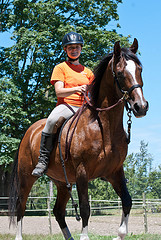
Three-Day Eventing is an Olympic and international equestrian sport that originated in Europe as a competition to demonstrate the fitness of cavalry horses. In those days, the armies wanted horses that looked impressive on the parade grounds, could travel across any kind of terrain at speed and for long distances, and then be ready and able to continue the next day. To test these abilities they developed a three day competition—in essence an equestrian triathlon.

The first day the horses demonstrate their dressage skills, performing intricate movements requiring high levels of training and obedience. The second day they show their courage, endurance, and ability to handle all kinds of difficult situations by completing a challenging cross-country course. The last day they prove their fitness by doing a precise and demanding stadium jumping round.

These tests developed into national competitions, culminating in becoming an Olympic sport in 1912. Initially, only military officers were allowed to compete. In 1952 male civilians became eligible, but women weren’t allowed into the club until 1964. Equestrian sports are among the few where men and women compete head-to-head. With a couple of exceptions—rodeo and racing—male strength is not a particular advantage and both sexes can be equally successful.

Eventing has become a popular activity for all levels of riders. You can start out on very easy Beginner Novice, Novice or Training courses, then move up to Preliminary, Intermediate and Advanced. You can also take part in one day events known as Horse Trials.

A horse and rider compete either as individuals or, at the international level, also as members of a team. Scores are computed on the numbemedium_2568292756r of faults a pair collects. As in golf, the lowest score wins. You acquire faults through mistakes in the dressage test and refusals, course mistakes or taking too long in the two jumping portions. Three refusals or a fall of horse or rider will result in elimination. Horses are also eliminated if they don’t pass the daily vet inspections.

The most important qualifications for the horse and rider are courage and fitness. The horse has to trust her rider and be willing to go where asked, sometimes jumping blindly, not knowing what is on the other side. Of course, the rider has to be equally brave, trusting that the horse can do what he asks and will keep him safe.

One year I served as a jump judge at a local Intermediate championship. This involved sitting by a large wood pile jump and watching to see if any horse refused, totally missed the jump, or fell. While I had done some cross-country for fun, I’d never tried anything the size of that wood pile. The sight of those horses tearing downhill and then having to slow and gather themselves to jump had my heart in my throat a good part of the time. Unfortunately, one rider did not get her mount back enough so the pair did not make it and fell hard. The rider got up sooner than the horse. There was no question of it doing anything more that day. That was the inspiration for a similar incident in my book Forewarning. My heroine Kasey Edwards is a former Three Day competitor.

Just as vital is the athletic ability of both. Top ranked riders cross-train, ride multiple horses daily and are extremely fit. They also put in long hours conditioning their horses to be able to finish the grueling second day.

medium_8123864734Unlike most other Olympic sports, Three-Day Eventing started as an Olympic event and then developed as a more general contest. The Badminton Horse Trial in Great Britain was the first major non-Olympic event and is still considered the most prestigious. The premier Three-Day in the US in the Rolex, held at the Kentucky Horse Park in Lexington, Kentucky.

While the limited TV coverage of Eventing in the Olympics used to concentrate on jumping falls, the increased public interest has resulted in actually being able to see portions of all three events. Below are a couple of videos.

.

Three Day Eventing:  http://www.youtube.com/watch?v=_Fqjo9EST8I
2012 Rolex:  http://www.youtube.com/watch?v=nfYJjdggyq0
The Cross-Country Ride to London: http://www.youtube.com/watch?v=Q8aShtqmJ_o

.

.

photo credit: <a href=”http://www.flickr.com/photos/21795222@N06/2568292756/”>clickerjac</a&gt; via <a href=”http://photopin.com”>photopin</a&gt; <a href=”http://creativecommons.org/licenses/by-nc-nd/2.0/”>cc</a&gt;
photo credit: <a href=”http://www.flickr.com/photos/zlatko/8123864734/”>Zlatko Unger</a> via <a href=”http://photopin.com”>photopin</a&gt; <a href=”http://creativecommons.org/licenses/by-nc-nd/2.0/”>cc</a&gt;

Categories: dressage, Horse Trials, Horses, Kentucky, nature, Olympics, outdoors, riding, Three Day Eventing, training horses, Uncategorized | Tags: , , , , , , , | 15 Comments

A DREAM COME TRUE

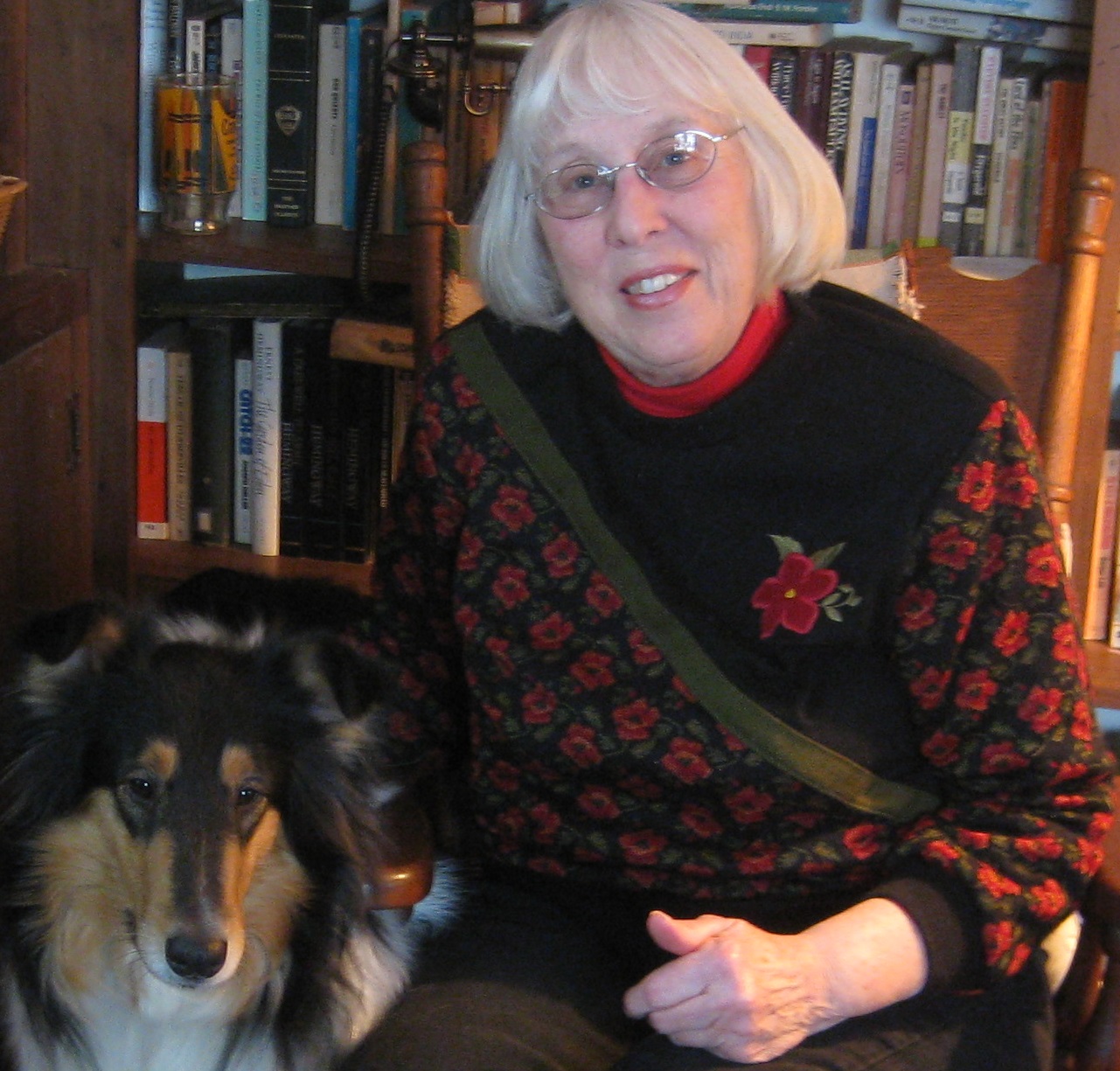
GloriaToday I’d like to welcome Gloria Alden author of the Catherine Jewell mystery novels The Blue Rose and Daylilies for Emily’s Garden. Gloria is a former third grade teacher who is spending her retirement writing short stories and novels. Her published short stories include “Cheating on Your Wife Can Get You Killed,” winner of the 2011 Love is Murder contest; “Mincemeat is for Murder” which appeared in the Bethlehem Writers Roundtable, “The Professor’s Books” in the FISH TALES Anthology; and “The Lure of the Rainbow” in FISH NETS, the newest Guppy Anthology. Her latest novel Ladies of the Garden Club will be coming out soon.

************

A DREAM COME TRUE

When I was a young girl, I galloped everywhere hitting my thigh to go faster on my imaginary horse. I galloped through fields and woods leaping logs, galloped across the road to my cousin’s house or to my grandparents farm and sometimes further down the road to another cousin’s house. Sometimes I rode Wildfire, and sometimes it was Thunderhead or Flicka or another horse in my stable of horses. I dreamed of someday having a ranch in the west with hundreds of horses.

I think my love of horses came from the story my dad told of a pony he rode one summer in the mining town in Pennsylvania where he grew up. My grandfather was foreman of the mining stable. The superintendent of the mine bought a beautiful black pony for his son, and it was kept in the mining stable. The pony tossed the boy the first time he tried to ride it so the superintendent asked my father, about the same age as his son, to ride and gentle it. All summer my father rode that pony, but the superintendent’s son never got over his fear of it so the pony was eventually sold.

During my galloping period, I read every horse book in my small rural library numerous times, and at Christmas I usually got a horse book, too. I dreamed of horses and drew pictures of horses, but I was thirty-eight years old before I finally got my first horse. My husband heard of a horse for sale and took me to see it. Of course, I fell in love with that strawberry roan paint. I thought he was beautiful. A few days later he was delivered. We had no barn, no saddle or bridle or even a lead rope. We did have hay, grain and a water bucket.

We put him in a shed and a few days later my husband and young teenage sons started building a barn – a large barn with five stalls. A week after my horse arrived, I now had a saddle and bridle.  I was ready for my first ride on my very own horse. Now, mind you, my riding had been very limited over the years. Mostly it was while we were on vacation and found a riding stable where you paid for an hour ride with a group on trails following a guide. Seldom did we move out of a walk, but maybe we’d trot a little and once in a great while gallop for a few minutes. Neither my husband nor I had ever saddled a horse, but we’d watched while these trail horses were saddled so we knew how to do it. Or so we thought.

As soon as the horse was saddled, I mounted and headed down a trail into the woods beside our home. He was a high stepper and both of us were eager to be out and on the trail. I was euphoric. His ears were perked forward interested and curious as we went along. And then I turned him around to head back. Maybe I should have thought twice about buying a horse named Rebel because as soon as we were heading back, he took the bit in his mouth, and I couldn’t slow him down. He was heading home, and just where that home was in his mind, I didn’t know. It was then I felt the saddle slip. I learned from that experience, you always tighten the girth, wait a bit for the horse to relax and then tighten it more. Anyway the saddle slipped and ended up under Rebel. Fortunately, I was able to kick my feet free from the stirrups and landed on the ground still holding onto his reins so he didn’t end up in some other county. He jumped about trying to get rid of that thing, but fortunately, I was able to unbuckle the saddle and not get kicked or stepped on.

So at the end of my first ride on my very own horse, I walked home with a saddle on my back now leading a docile horse. It wasn’t exactly the way I had envisioned that first ride. Eventually, Rebel was sold. He was a rebel. Over the years there were other horses and ponies. Once we had five at one time, one we boarded for a friend. My four kids joined 4H, and I became proficient at saddling and caring for horses. I learned to pull a horse trailer to take them to shows and for riding lessons and even took riding lessons, too.ponies2

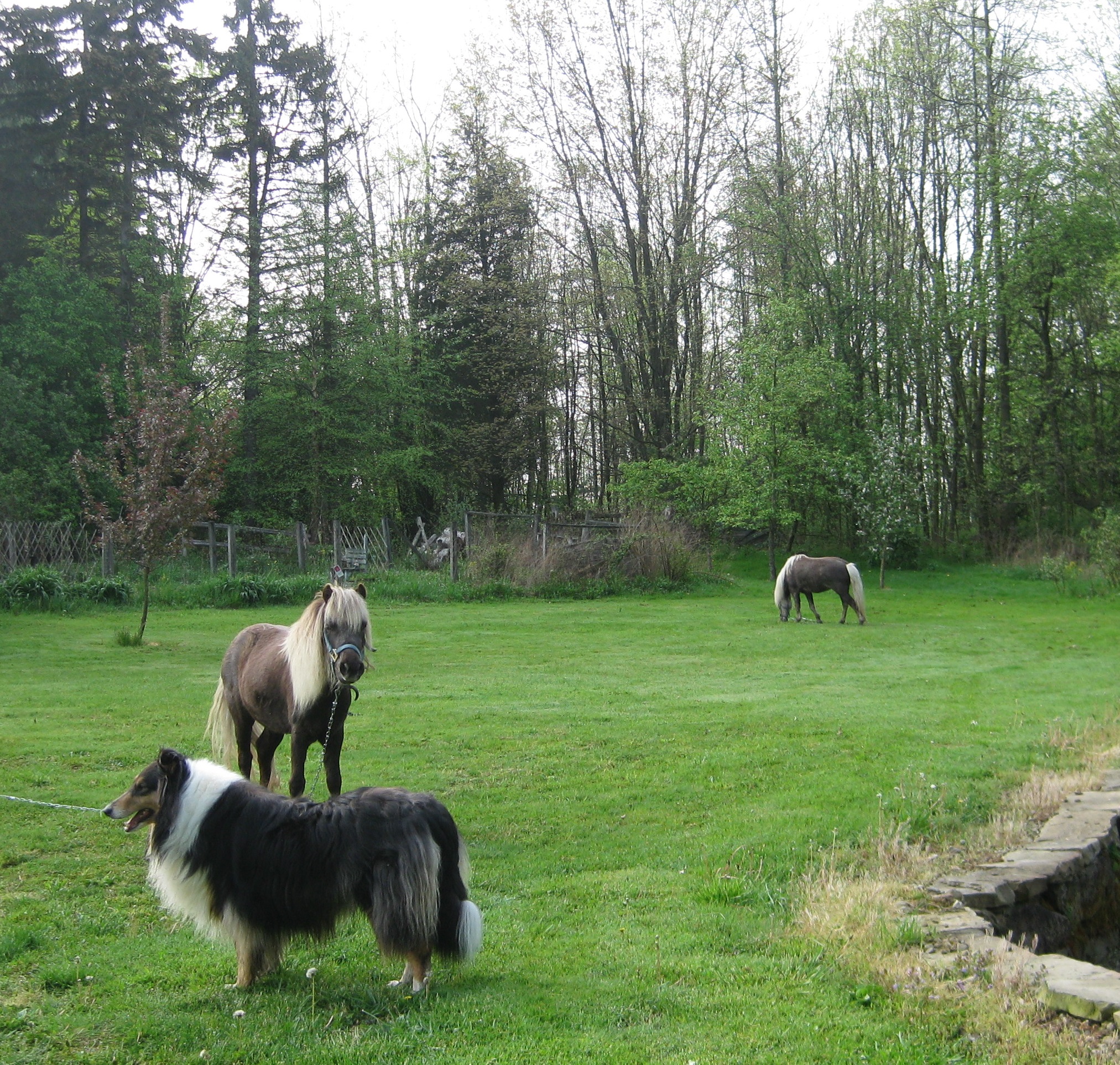
Then there came a day when I had to move. I had to sell my last two horses because I didn’t have the money to put new fencing around the pasture of the small farm I bought. The house needed too many repairs and the barn needed a new roof. But my love of horses never went away. However, I down sized the dream. Now I have two totally useless small ponies – sisters – that I rationalize keeping as being compost makers for my gardens, but it’s really because I love them.

What dream did you have when you were young? Did it ever come true?

*********

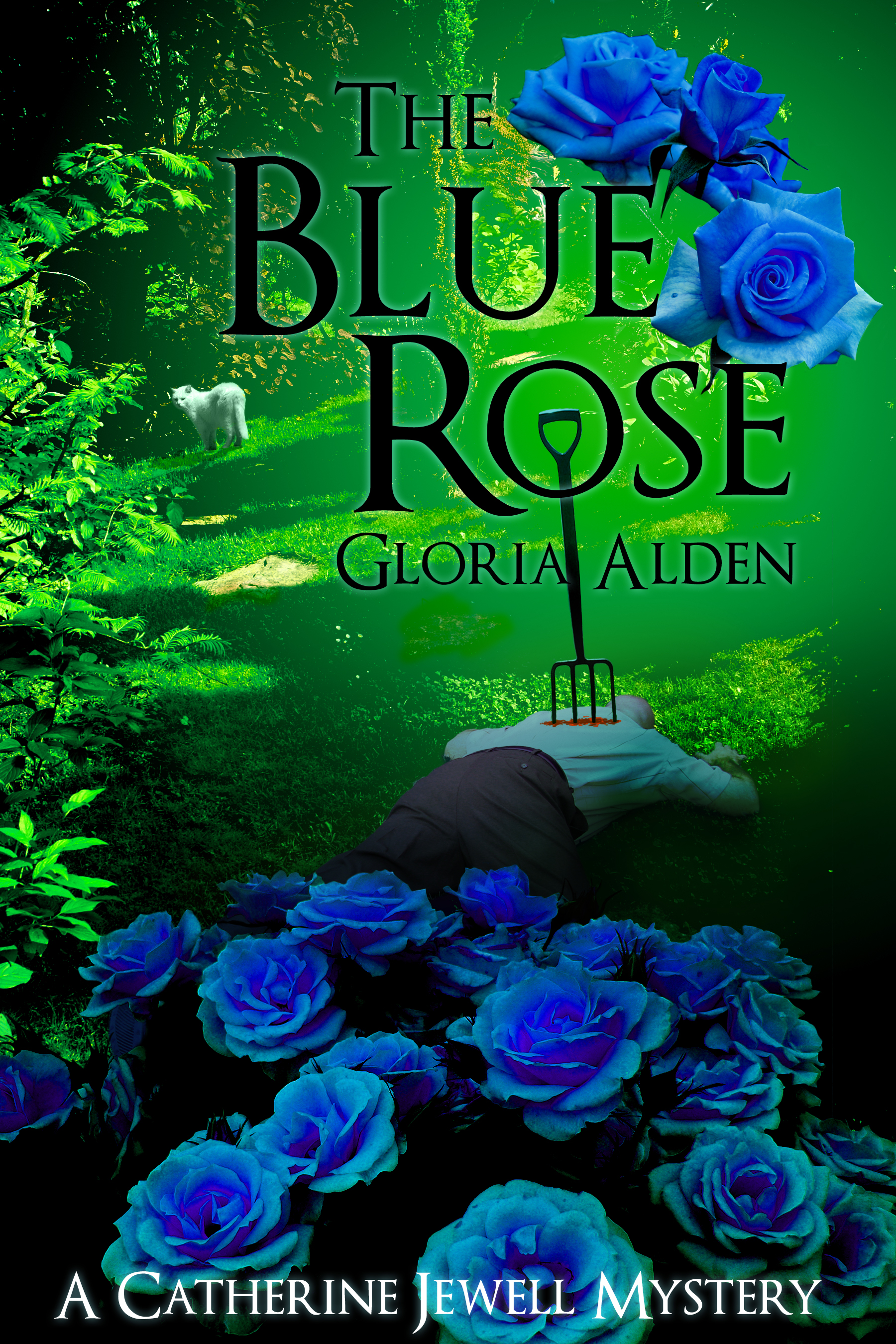
blueRose_flatIn The Blue Rose Catherine Jewell enjoys the small quiet town she’s recently moved to where she’s a botanist at Elmwood Gardens and also has a small garden center, Roses in Thyme. At least she does until she discovers a body with a garden fork in his back at Elmwood Gardens. John MacDougal, the police chief of Portage Falls, has never had to deal with a murder in his ten years as police chief. As he questions the suspects, many who are Catherine’s co-workers and friends, she works to divert his suspicions elsewhere since she’s sure none of them could be the murderer. When another body is discovered, they start working together, and in spite of their inexperience and several close calls with death, they solve the murders and restore calm to the little town of Portage Falls.

.

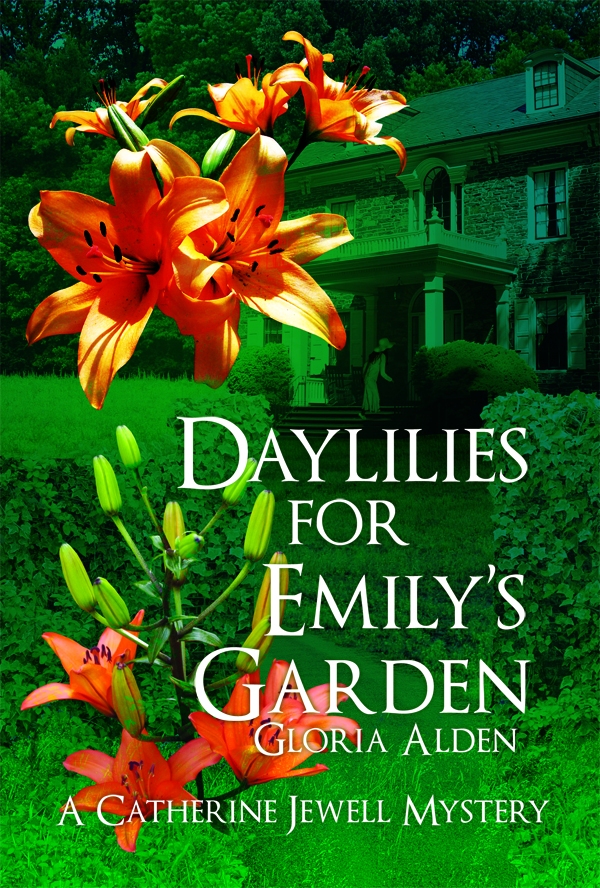
In Daylilies for Emily’s Garden Catherine Jewell is excited about restoring the gardens at the estate ofdaylilies_frontPreview1 the reclusive Emily Llewellyn. Everything for this project is arranged through Charles McKee, her secretary and companion. Catherine’s curiosity of this eccentric recluse is piqued when her only contact with Emily is through brief glimpses of her through a window before she quickly disappears. Catherine’s excitement dims a little when she discovers a dead body. Meanwhile other unsettling events are going on in Portage Falls. A bypass coming closer to town threatens wet lands and the residents are divided on the next phase of the construction.  When environmental activist Bruce Twohill comes to save the wetlands some consider him a savior while others like Police Chief John MacDougal are suspicious of this stranger. Another dead body is discovered and the buzz around town thinks it’s connected with the first body.  Returning characters from The Blue Rose plus new and interesting or quirky characters add color to the small town of Portage Falls in this second book in The Catherine Jewell Mystery Series.

.

Both books are available on Amazon and Smashwords

************

You can contact Gloria at:
Website: www.gloriaalden.com
http://writerswhokill.blogspot.com

Categories: Horses, Mystery, nature, outdoors, ponies, riding, Romantic suspense, Trail riding, Uncategorized, writing | Tags: , , , , , , , , | 7 Comments

Draft Horses – Gentle Giants

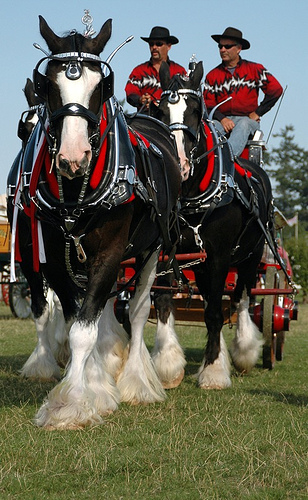
219597161_deb25f55f6_nEvery winter when I was a kid, my friends and I looked forward to the week before the Pasadena Rose Parade. That was the time when the Budweiser Clydesdale horses came to town and stayed at our local stable. We’d all ride (horses or bikes) up to the barn and hang out for hours watching their handlers bathe and groom the gentle giants. We’d never seen horses that big—approximately twice the size of our own. The average riding horse stands around 15 hands tall (five feet at the withers, where the neck joins the back) and weighs about 1000 pounds. The Clydes stood 18 hands (six feet) and weighed around 2000 pounds. They were so big their grooms had to stand on long tables in order to reach the top of their backs and necks. Their feet were three to four times bigger than our horses’ hooves and their huge horseshoes were said to weigh five pounds. They were a wonderful, exotic sight.

Of course 50 years earlier they wouldn’t have been exotic at all. For millennia draft horses were the tractors and trucks of the world. They pulled plows to work the land, logged the forests, hauled freight wagons and coaches, and sped the early fire wagons to their destinations. During World War I, the U.S. shipped more than 1,000,000 horses to Europe to haul artillery and pack supplies and ammunition.

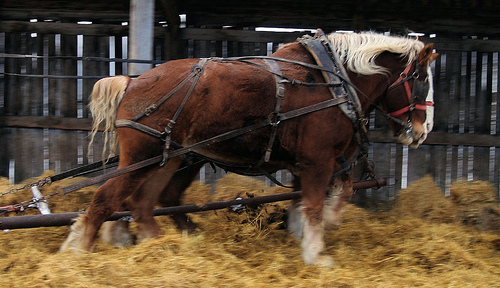
The conformation (build) of draft horses differs from that of riding horses because they are used for pulling, instead of carrying. In addition to being big and medium_343344475powerful, they have an upright stance, which is better for working in harness, and huge hindquarters that, combined with their over-large feet, give them tremendous pulling power. Most also have lots of hair, known as feathers, on their lower legs, heavy bones and either straight or roman noses. They come in a variety of sizes, ranging from about 1300 pounds to over 2400. The largest horse on record, a Shire named Samson, was 21.2 hands high and weighed approximately 3,300 pounds.

No matter the breed, one characteristic all drafts have in common is a calm, sweet temperament. While a fiery, aggressive attitude might be desirable or at least tolerated in some riding horses, a 2000 pound hot-head would be extremely dangerous. So they’ve been bred to be patient and docile. Children routinely handle the powerful animals. The faithful, loving farm horse is not a myth.

Drafts were vitally important to American agriculture from about 1820-1920. Before that oxen were cheaper to use. But a revolution in farm machinery required bigger, more powerful and faster animals, so the work horse came into its own and helped create the breadbasket of America. Then in the 1920’s the motor vehicle entered the picture. Tractors and trucks took over and the number of drafts decreased dramatically, with some breeds actually becoming endangered.

In the 1960’s people became interested in them as pleasure animals medium_410928490and their popularity grew. Today they are mainly used at shows and parades, in pulling contests and for carriage and wagon rides. However, some are again being used for logging and farming too.

Drafts are also sometimes crossed with lighter riding horses to create sturdier sport horses used for jumping and cross-country competitions. While most drafts are used in harness they most definitely can be ridden and you will see them both on the trails and in the show ring.

Here are a couple of videos showing draft horses in action.

http://tinyurl.com/mg92hu4

http://tinyurl.com/k5vbsne

.

Clydesdale photo:  http://www.flickr.com/photos/trinity/219597161/sizes/s/in/photostream/
Draft photo:  http://tinyurl.com/mfw3ce2
Three horses photo: http://tinyurl.com/ms8al65

Categories: Clydesdales, draft horses, Horses, Uncategorized | Tags: , , , , , , | 6 Comments

Horses are Characters, too…

.

JoAnn_hands_chinWingsEdit-v2_300Today my guest JoAnn Smith Ainsworth talks about a very special animal that helped her through a difficult time in her life.

When JoAnn Smith Ainsworth carried wood as a pre-teen so her Great Aunt Martha could stoke up the iron stove to prepare dinner, she wasn’t thinking, “I could use this in a novel someday.” Yet, the skills she learned from her horse-and-buggy ancestors translate into backdrops for her historical romance and paranormal suspense novels.

Her most recent release is Polite Enemies, published by Whiskey Creek Press and available as an ebook too. Here’s JoAnn.

******

POLITE ENEMIES features a farm horse, Old Molly, who appears in many high-profile scenes. In 1895 Wyoming, Old Molly thwarts outlaws, hauls equipment to fight a fire and, notwithstanding exhaustion, comes out of the barn one more time for the heroine to defend her hero. Old Molly has a personality that makes her one of the story characters.

Old Molly has been with the family for over a decade. Whether called upon to pull a plow or haul a load of farm produce to town, Old Molly placidly does her duty. The hero is a rancher so there are other, more powerful horses in the novel, but none of those horses have the personality and importance of this tried-and-true farm horse.

Incorporating a horse with a “personality” into POLITE ENEMIES came from my own experiences as a horse owner. I owned a horse for a few years and he played a central role in my life.

Sensacional was a Peruvian Paso with dark coloring, an almost-to-the-ground, black tail and a flowing, black mane. He had a very smooth, specialized gait, (which looked like this horse riddenSilvano Taipe show horse by my trainer, Silvano Taipe). Sensacional played a major role in helping me survive the transition of my son from a dependent child into an antagonistic teenager and, finally, into an independent young man. I had to learn to step away, to give my son enough space so he could grow. Sensacional was the “crutch” that helped me through the transition. He kept me from a mother’s despair as her child pulls away from her.

Sensacional was a rescue horse. In a way, we rescued each other. He was a beautifully trained gelding with quality features, but his owner died suddenly. Those family members dealing with a human death forgot about the horse. Not being fed and watered, Sensacional went to skin and bones. By the time I got him, he was too weak to carry a person. The trainer spent a few months to fatten him up and rebuild muscle tone. We took long walks together while Sensacional was unable to carry weight.

I would speak to him as we walked and he seemed to understand and accept the bond of mutual need being built. Although he was a show horse at one time, I wanted him for trail rides on a Napa County recreational ranch. Peruvian Pasos can cover miles with ease and provide a smooth ride because of their gait. As Sensacional responded to food and exercise and companionship, we became closer. Eventually, he was fit for trail rides.

My mothering instinct traveled from my son to my horse. Where my son rejected fussing and care, Sensacional loved being coddled and groomed. The horses in POLITE ENEMIES benefitted from my experience.

As is the nature of things, during this time my son and I became more estranged, but Sensacional took the sting out of it. It took my son into his early twenties to return to a belief that parents might have some value in this world. It took Sensacional less than a year to return to his original beauty and most of his strength, but the starvation had taken a toll on his health and shortened his life span. Sensacional neared the end of his days and passed out of my life at a time when my son reached his maturity and eventually came to believe a mother might be worth acknowledging once again.

Have you ever had an animal which helped you over hard emotional times? Describe your experiences for us.

********

Polite Enemies COVER_300x200IDA LOUISE OSTERBACH survived Indian and range wars and the murder of her husband. She’s kept the farm going through sheer grit and the help of her cousin, a friend and two farm hands. She’s managed a profit, paid the mortgage and re-paid the crop loans. Hard working, focused, fiercely proprietary, the last thing she has time for is romance.

JARED BUELL—widower neighbor and wealthy rancher—was never particularly charitable when it came to farmers, even eye-catching ones like Ida. He’s not looking to start trouble or anything else with her. His comfortable existence needs no complications, thank you very much. Then an old nemesis comes to town and threatens his and Ida’s property. He has no choice but to get involved.

Experience this action-packed romp through 1895 Wyoming where an outlaw schemes to take over the town and Ida and Jared find love when they least expect it.

Read an excerpt at http://bit.ly/1epn2aM.

******

Contact Joann at:

http://www.joannsmithainsworth.com

joannparanormal@gmail.com

Visit @JoAnnAinsworth on Twitter and Facebook.

Categories: Horses, nature, Romantic suspense, Uncategorized, Western romance, Wyoming | Tags: , , , , , , | 13 Comments

Personalities and Horses

Last week I posted about how sex or gender influences how horses interact with the world and you, as a rider or trainer.  But that isn’t the only thing you need to be aware when handling these wonderful animals. Just like people, horses have very different and distinctive personalities. Some of these are easy to live with and others are quite challenging.

(I still haven’t quite caught up from being gone most of last month, so I am again reusing parts of an early post which ties in with last week’s.)

My first instructor in this area was my horse, Star, who I’ve talked about before. small_4888162686I became pretty successful in teaching her to do a lot of different things. Then her second son, Junior, came along and I discovered I needed a different set of tools to work with him. And this has been true with each horse I’ve dealt with.

You can classify horses as having four basic personalities. They can be Extroverts or Introverts. They also can be Thinkers or Reactors (emotional). This means you can have an extroverted-thinker, an extroverted-reactor, an introverted-thinker and an introverted-reactor. Then you add their gender and their experience into the equation and you have a complicated being that requires some thought to train effectively. Each personality type has its pluses and minuses and is good for different things and different riders.

Star was an extroverted-thinker. She was friendly, self-confident, rarely afraid of anything and willing to try whatever I asked her. She was also strong-willed and could be difficult. Horses are prey animals and, as such, are basically “scaredy cats.” In the wild they stay alive by being hyper-aware of their environment and ready to run on an instant. Domestication hasn’t done away with that basic instinct. A horse whose emotions dominate sees threats everywhere and can react without thinking. My Portia was a prime example. When I first got her, she would whirl and try to bolt at the slightest provocation. Typical extroverted-reactor.

Star, on the other hand, rarely reacted to anything. Her version of a spook was to stop, study the offending object for a minute and then go up and sniff it. She had grown up along a railroad track and had experienced earth moving equipment moving around her space, so she learned early thatsmall_4125411682 loud noises and big things weren’t usually dangerous. Given her basic self-confidence, she extended this attitude to the rest of her world. You could surprise her, of course. She wasn’t bothered by the fire engine racing down the street, but nearly jumped onto our neighbor’s porch when it suddenly blasted its siren right alongside her. Scared the dickens out of me too!

Because of her personality, Star was easy to teach, once we started communicating properly. She enjoyed learning, experiencing new things and exploring new trails. Portia liked to learn too but got upset easily, which shut down her brain. On the other hand, Glory, an introverted-reactor, is harder to teach because she’s afraid to try new things. And my husband’s horse, Koko, an introverted- thinker, could be down right stubborn about trying anything new. So I have had to adjust my methods for each personality.

Being aware of these personalities also helps you when you pick out a horse to own or work with. Some people do better with one type, and others do better with a quite different one. Since I’m more of an introverted-thinker, dealing with a horse of the same style would drive me bonkers in the long run. We’d probably both fall asleep. I do much better with the reactors who need to be calmed down. This wouldn’t be true of someone who had an emotional nature. They would be better at energizing a thinker.

What personality type are you?  What types do you like best?

.

photo credit: <a href=”http://www.flickr.com/photos/pictureclara/4888162686/”>Clara S.</a> via <a href=”http://photopin.com”>photopin</a&gt; <a href=”http://creativecommons.org/licenses/by/2.0/”>cc</a&gt;
 
photo credit: <a href=”http://www.flickr.com/photos/abejorro34/4125411682/”>abejorro34</a&gt; via <a href=”http://photopin.com”>photopin</a&gt; <a href=”http://creativecommons.org/licenses/by-nc/2.0/”>cc</a&gt;
Categories: horse personalities, Horses, nature, outdoors, riding, training horses, Uncategorized | Tags: , , , , , , , | 4 Comments

The Evolving Mermaid

Joanne Guidoccio is my guest today and she will be talking about mermaids, since a mermaid is the heroine of her debut novel, Between Land and Sea.

Guidoccio 001In high school, Joanne dabbled in poetry, but decided to wait until she had more life experiences before writing a novel. The original plan was to get a general arts degree and take a few years off to travel and write. Instead, she gave in to her practical Italian side and obtained degrees in mathematics and education.

While she experienced many satisfying moments during her teaching career, she never found the time and energy to write. In 2008, she took advantage of early retirement. Slowly, a writing practice emerged and her articles and book reviews started appearing in newspapers, magazines and online.

Her debut novel, Between Land and Sea, a paranormal romance about a middle-aged mermaid, has just been released by Soul Mate Publishing.

THE EVOLVING MERMAID

When I announced the release of Between Land and Sea, a novel about an overweight, middle-aged mermaid, I was surprised by the subsequent comments.

The typical male response was a Duchenne smile followed by a puzzled expression and several pointed questions…

Why is she so old?

 Just how overweight is she?

 What happened to her?

The men had preconceived notions of what a mermaid should look like—wavy auburn tresses, mesmerizing green eyes and a curvaceous twenty something body.

The women, on the other hand, were intrigued by a mermaid who did not fit the stereotype and wanted to hear more about her reinvention story.

When it comes to mermaids, there can be no real consensus on their appearance. After all, they are only fictional characters subject to the whims of different cultures and time periods.

According to Greek mythology, Sirens were originally thought to be deities who had fallen from their position among the Greek gods. There is some discrepancy regarding the number of Sirens who lived off the coast of Greece (or possibly Italy). Anywhere from two to five Sirens lived on this island and lured men to their deaths with their bewitching songs. Descriptions of the Sirens varied; in some of the older myths, they had the head of woman and the body of a bird.

In Homer’s Odyssey, Odysseus had himself tied to the mast and ordered his men to stuff balls of wax into their ears while approaching the Sirens’ island. Only by taking these drastic measures could Odysseus ensure that no one jumped off, swam to shore, or endangered the lives of the crew. The songs of the Sirens were so hypnotic that sailors would become distracted and often steered the ship into dangerous waters or onto jagged rocks.

Among seafaring people, there are several historical claims of actual mermaid sightings. In 1610, Captain Richard Whitbourne claimed he saw a mermaid in Newfoundland’s St. James harbor. A young boy in Scotland (circa 1820) is believed to have killed a mermaid by throwing rocks at it. Unlike the beautiful Sirens in the Greek myths, the dead mermaid resembled a three-year-old child, but had a salmon’s tail instead of legs. The villagers had a funeral for the mermaid and buried it in a small coffin.

Hans Christien Anderson immortalized a kinder, gentler mermaid in The Little Mermaid. While it was my favorite fairy tale, I felt so sorry for the mute ex-mermaid who could only smile when the handsome prince married someone else. Knowing that the prince’s wedding morning would only bring heartbreak and seal her fate as “foam on the crest of waves” always saddened me.

I wanted a happily-ever-after ending for the little mermaid and the prince. But when the Disney version was released, I still wasn’t satisfied. I realize now that I wanted to read about a different kind of mermaid, one who could enjoy a happy and successful life, with or without the prince. And maybe one who wasn’t quite so young or so beautiful.

Keeping this vision of an older and wiser mermaid firmly in mind, I wrote Between Land and Sea, the first book in the Mediterranean trilogy.

*****

 betweenlandandseacoverAfter giving up her tail for an international banker, Isabella of the Mediterranean kingdom is aged beyond recognition. The horrified banker abandons her on the fog-drenched shores of southwest England, leaving her to face a difficult human journey as a plain and practically destitute fifty-three-year-old woman.

With the help of a magic tablet and online mermaid support, Isabella evolves into the persona of Barbara Davies. Along the way, she encounters a cast of unforgettable characters, among them former mermaids, supportive and not-so-supportive women, deserving and undeserving men, and several New Agers.

.

.

*****

EXCERPT

Isabella stumbled as she got out of bed and tried to balance herself on the stumps that now served as permanent legs. She willed herself not to cry as she recalled the magnificent tail that had been the envy of the Mediterranean kingdom. Her mother and grandmother had also been blessed with the same tail. Now only Annabella held this birthright.

She heard her stomach growl and thought longingly of her favorite kelp dish. She closed her eyes and visualized the steaming goodness that would satisfy her hunger. And then she remembered that she could no longer manifest her desires.

No more powers. No more comfort and ease.

Her lips trembled as she looked about the small, neat room filled with large wooden pieces and smaller metallic ones. She tried to move one of the larger pieces and then gave up in frustration. Andrew had promised her a beautiful home with servants, and now she must live this life of ordinary humans.

The flickering of a green light caught her attention. She approached and noticed the tablet lying on one of the wooden surfaces. It was blinking at her. Tentatively, she touched the green light. The blinking stopped and a smiling face materialized.

“Greetings, Isabella. I am Lisa738. Annabella has asked me to guide you through your orientation.”

Isabella frowned and tried to recall her connection to this lowly mermaid from the Numbers class.

*****

Where to find Joanne…

Website: www.joanneguidoccio.com

Amazon: http://is.gd/AVpoVs 

Twitter: https://twitter.com/joanneguidoccio

Facebook: www.facebook.com/BetweenLandandSeaJG

Pinterest: http://pinterest.com/jguidoccio/

Goodreads: https://www.goodreads.com/author/show/7277706.Joanne_Guidoccio

YouTube (Trailer #1): http://www.youtube.com/watch?v=xipZ6quZDOs

YouTube (Trailer #2): http://www.youtube.com/watch?v=nfiKOQe_yuU

Categories: fantasy, mermaids, nature, outdoors, romance, Uncategorized | Tags: , , , | 14 Comments

Sex and the Single Horse

Due to attending the Emerald City Writer’s Conference in Seattle last weekend I’m recycling another early post. This one deals with how the sex of a horse influences how you deal with him or her. Next week I plan to get back to my regularly scheduled posts.

There is an old horseman’s saying: You can TELL a gelding what to do, you should ASK a mare and must NEGOTIATE with a stallion. Many people either are unaware of how important gender can be or think it doesn’t matter. This can interfere with them getting the best from their horses.

small_4858113130  A gelding is a male horse that’s been neutered. As such, he’s no longer ruled by his hormones and tends to be more even tempered. Most are gelded when they are quite young and often remain “child-like” with a relaxed and playful attitude toward life. Of course, breed and personality influence things too. Some are bred to be hot and excited, such as the thoroughbred, and some are bred to be laid back and cooperative, such as draft horses. But in general, a gelding is easier to deal with.

.

Mares, on the other hand, are quite influenced by hormones. From early Spring to late Fall, they come into season about every 21 days unless impregnated. For some this issmall_2645376508 a big deal and they can be unpleasant or irritating to deal with. Most just get a little touchy and distracted. And just like with people, when someone isn’t feeling their best or isn’t attentive, it’s not wise to try to force an issue. Also because of the biological imperative to have babies, mares tend to have a more serious attitude toward life. This means they can get insulted quite easily. That can provoke a sullen shutdown, fearful withdrawal or determined resistance depending on their personality. But their mothering instinct is also a big plus. They want to cooperate and please and most will try their hardest for you if you ask nicely.

Stallions have small_2431865552one purpose in life – to breed and protect their mares and babies.  They are the ultimate alpha males. As such they can be quite difficult to live with and that’s why most males are gelded. Given how powerful and determined they are, you don’t want to provoke a fight. It’s unlikely to end well. All horses need to be taught to respect and obey humans, and this is vitally important with a stallion. The scent of a mare in season can turn an untrained stud into a dangerous time bomb and be a potent distraction for the well-trained. So, you have to take into account the forces driving them and figure out how to negotiate their cooperation. The results can be spectacular.

.

Have you noticed or had experience with sex differences in any animals? If you’re into horses, which do you prefer?

.

Brown horse and rider: photo credit: <a href=”http://www.flickr.com/photos/highwayoflife/4858113130/”>Highway of Life</a> via <a href=”http://photopin.com”>photopin</a&gt; <a href=”http://creativecommons.org/licenses/by-nc-nd/2.0/”>cc</a&gt;
Mare and foal: photo credit: <a href=”http://www.flickr.com/photos/nomanson/2645376508/”>nomanson</a&gt; via <a href=”http://photopin.com”>photopin</a&gt; <a href=”http://creativecommons.org/licenses/by-nc/2.0/”>cc</a&gt;
Stallion: photo credit: <a href=”http://www.flickr.com/photos/valeehill/2431865552/”>valeehill</a&gt; via <a href=”http://photopin.com”>photopin</a&gt; <a href=”http://creativecommons.org/licenses/by-nd/2.0/”>cc</a&gt;
Categories: horse care, horse personalities, Horses, nature, riding, training horses, Uncategorized | Tags: , , , , , , , , | 12 Comments

The Dogs in My Life

Morison-Knox_Karen-7748-Edit-webToday Ariel Moon is visiting to talk about the dogs in her life and how they’ve influenced her books.

Ariella Moon writes about magic, friendship, secrets, and love in Spell Check, Spell Struck, and the upcoming Spell Fire, the first three books in The Teen Wytche Saga from Astraea Press. After a childhood spent searching for a magical wardrobe that would transport her to Narnia, Ariella grew up to become an author and shaman. Extreme math anxiety, and taller students who mistook her for a leaning post, marred Ariella’s teen years. Despite these horrors, she graduated summa cum laude from the University of California at Davis. She now lives a nearly normal life with her extraordinary daughter, shamelessly spoiled dog, and an enormous dragon.

Welcome Ariel.

****************************

I was about five-years-old when a cocker spaniel-mix wandered into our neighborhood in search of food, water, and love. He was malnourished and had whip scars on his back. My family took him in, though in truth, the whole neighborhood adopted him. Blackie listened to my childhood secrets and licked my nose when I cried. His appearance marked the beginning of my life-long love of dogs.

Years after Blackie’s passing, my mother acquired a Schnauzer named Fritz. By then we had moved to a Christmas tree farm. An older German couple that arrived after Thanksgiving each year to pick out a Douglas fir particularly admired Fritz. I called him Wrong Way Fritz. If deer were in the apple orchard and I yelled, “Deer!” Fritz would run into the Christmas trees. If I spotted a squirrel among the Christmas trees and yelled, “Squirrel!” Fritz would dash to the orchard.

When I married, our first dog, a blond lab-mix named Tasha, would scale six-foot wooden fences to escape our backyard. She left behind Emily, a Jack Russell terrier. A breeder had scheduled Emily and her siblings to be euthanized because their noses were brown, not show-worthy black. Emily became my baby. She lived to be seventeen, and though she died twenty years ago, I mourn her still. Her companion, Miko, was a beautiful white shepherd. Madchen, another white shepherd, taught me a difficult lesson about recognizing — and avoiding—puppy mills. Rare dog-less years followed. Finally we rescued Jack, an overprotective Jack Russell terrier. Jack underwent a devastating personality change after we had him neutered —another painful lesson learned.

Our short string of bad dog luck ended with Honey, a black retriever-mix with golden paws. True, she had severe epilepsy and had to be heavily medicated. But she was worth every penny we paid for medication and vet appointments. Honey and I hiked everywhere together. When a seizure would hit her on the trail or in the middle of the street, neighbors would stop and wait with me until Honey could rise again. After she passed away, the whole neighborhood mourned. Around Halloween, when the veil between worlds is the thinnest, neighbors would stop me on the street and say, “I was just thinking about Honey.”

I immortalized Honey in my Young Adult series, the Teen Wytche Saga. She appears as Baby the —what else—black retriever-mix belonging to Evie O’Reilly, the protagonist in Spell Check, the first book in the series. Baby’s foil, Einstein, an unrepentant cockapoo, is an ode to all the strong-willed dogs I have known. Like Baby, Einstein appears in the first two books in saga, Spell Check and Spell Struck.

When Honey and I used to walk in our old neighborhood, we’d sometimes encounter a woman with two of the mangiest, toothless, such-a-mess-they-are-adorable, rescue Yorkies. I couldn’t resist giving them pivotal roles in Spell Struck.

In part, I include dogs in my books because they reveal character and add humanity and sometimes humor. The absence of canine companions in my upcoming novel Spell Fire, (November 2013, Astraea Press) adds an unspoken layer to the main character’s isolation. Since I couldn’t give my protagonist a dog, I gave her a dragon. Which brings me to Gracie, my daughter’s I-know-Honey-will-die-soon-so-here’s-a-new-dog-so-you-won’t-follow-me-to-college present. Gracie is the first magic-practicing animal I’ve ever lived with. No wonder. Did I mention her breed? Gracie is a Papillon-Chihuahua-Poodle-Dragon Hatchling-mix. I’m sure she will magic her way into some future book.

******************

Spell Struck

 Book 2: The Teen Wytche Saga

What if the one person who saw through your lies and loved you, harbored a secret that could cost you everything?

SpellStruck_500x750Goth outcast, Salem Miller, believes her love spell failed until Aidan Cooper arrives at Jefferson High. When he chooses her over the popular girls, Salem knows magic brought him. But can she summon enough wizardry to save her sister? Salem fears Amy’s next suicide attempt will succeed. Magic brought Aidan. Maybe it can cure Amy. Salem’s last hope lies hidden within a damaged grimoire, nearly destroyed by a wrongful love spell. Was her rightful love spell enough to restore it?

Newest Jefferson High transplant, Aidan Cooper, doesn’t expect to be attracted to a goth. Then he realizes Salem is throwing a glamour—pretending to be something she’s not. Guess it takes one to know one, since his whole life has been a lie. But if his kidnappers discover he’s broken their No Attachments rule, he’ll never see Salem again. Worse, he’s terrified they’ll harm her when they discover she possesses the ancient grimoire. To protect Salem, Aidan must destroy the grimoire, and escape his captors.

While Salem races to unlock the Get Well Spell, Aidan scrambles to overcome his past. With their star-crossed paths at odds, will time run out for both of them?

.

Excerpt:

Aidan lowered his hand. His finger pressed against my skin, shooting a delicious tingle up my arm. When I didn’t move away, he hooked his finger over mine. My breath caught. We stayed, frozen, hyper-focused, for what seemed like three lifetimes. Then Aidan trailed his fingertips across the back of my hand. The soundtrack, popcorn smells, and theater audience melted into the background. The world narrowed down to the unspoken grief and need entangled in Aidan’s touch.

I rotated my hand so my palm faced upward. Aidan hesitated. Our gazes locked in the flickering light. The spell link humming between us lit up like blue lightning. At least I think it was the spell link. Aidan plunged his fingers between mine. Our palms pressed together, igniting a current. Air shuddered from my lungs. Magic rippled from us in successive waves.

My heart stuttered. My breath ceased. Every cell within me vibrated. Troops of fairies or dragonflies took flight in my lower abdomen. It’s possible blue lightning shot from my boots.

Good thing I wasn’t holding the popcorn.

****************

Buy Links

Astraea Press

Amazon

Barnes & Noble

Where to Find Ariella Moon

Ariella’s website

Ariella’s Blog

Facebook

Goodreads:  http://www.goodreads.com/goodreadscomAriellaMoon

Categories: Dogs and cats, Paranormal, Uncategorized, writing, YA | Tags: , , , | 1 Comment

Best Friend … Best Teacher


Today,  I’m  talking about a very special horse in my life and what I learned from her. This is a repeat of one of my first blogs, but I think it illustrates how important it is to get to really know your horse–how he/she thinks, reacts and views life.

small__389080670We all turn to friends for fun, companionship and support with life’s difficulties. If we’re really lucky a good friend can also teach us a lot about life.

My best friend when I was a kid was a horse named Star. I had started riding off and on when I was four, but I didn’t get a horse of my own until I was ten. A year later I got the love of my young life. Star was a beautiful, liver chestnut (dark brown) Morgan mare who turned into the best pal a kid could want.

She didn’t start out that way, though. Six months after we bought her, I was ready to give up and try for another horse. While she was sweet and loving on the ground, she had been badly handled under saddle and was very hard to control on the trail as a result. There were few professional horsemen in my area. Most people bought horses with some basic training and just got on and rode. If a horse gave you problems, you tried a stronger bit and maybe a tie down. The advice we were given by more “experienced” people and even books was the harsh “make her behave” variety. I now know, of course, that was exactly the wrong approach for her.( See my early post Sex and the Single Horse where I talk about “asking” mares.)

One day when I was at a really low point, I began playing around with Star on the ground. When we bought her we also bought her yearling colt, Comet. My dad used to play with him and taught him a couple of tricks. Of course Comet got lots of carrots and praise when he did them right. For some reason that afternoon, I gave Star the signal for one of her son’s tricks…and SHE DID IT. I was flabbergasted and tried again and she did it again. It was then I realized that she really wanted the pats and treats too, which had not been many because of her “bad” behavior.

The next day I went to the library and got a book on teaching tricks. I started with the simple ones, such as bowing, counting, nodding “yes” and shaking her head “no.” I soon discovered I had an astonishingly smart horse who would do anything for a carrot and praise. Over the years we developed a large number of tricks and even put on demonstrations at small horse shows. But I also discovered I had a horse who would try her best if you asked her, but would fight like mad against anyone who tried to force her.

I spent a lot of time developing a good relationship with Star on the ground and she learned to trust me. I changed to a milder bit and tried to listen to her as I realized how much she wanted to please. Eventually, we became an inseparable team. We competed in small shows, jumped cross-country, danced in parades, led a Western drill team and covered hundreds of miles of trails. When things got difficult at home, I’d take off on her and find my peace.

Star taught me a different way to deal with life. My family’s approach to life tended to be harsh and critical. She showed me a gentler way to handle problems. And to try and see what was really going on rather than reacting to appearances. She taught me how to be a friend by being my best friend.

Did you have a good friend who taught you something special or made a difference in your life? Who are the people you value?

photo credit: <a href=”http://www.flickr.com/photos/bombeador/389080670/”>Eduardo Amorim</a> via <a href=”http://photopin.com”>photopin</a&gt; <a href=”http://creativecommons.org/licenses/by-nc-nd/2.0/”>cc</a&gt;
Categories: horse care, horse personalities, Horses, nature, outdoors, riding, Trail riding, Uncategorized | Tags: , , , , , , , | 16 Comments

Cats In my Stories

Welcome Andrew McRae today as he talks about how cats slip into his stories.

Andy-PG-Small

.

Andrew  is a misplaced Midwesterner who rolled downhill to the San Francisco Bay a quarter-century ago. He is the author of Murder Misdirected (2012) from Mainly Murder Press and “The Case of the Murderous Mermaid and Other Stories” (2013) a collection of whimsical murder mysteries. He has had numerous short stories published in the past few years; notably “Felony at Farquhar Farms” in the collection “The Killer Wore Cranberry: A Second Helping” (2012) and “Frankenstein and The Spanish Nun” in the collection “Moon Shot” (2013), both published by Untreed Reads.

.

*****************************

Cats have a way of slipping into my stories, the way cats do. I usually don’t plan on a cat appearing in a story when I first set out to write it, but cats are good at sneaking into places not intended for them, as anyone who has ever lived with a cat knows.

There is a bookstore cat in my novel, Murder Misdirected. His name is Junior and he is handsome, as all male cats are. He sees it as his duty to greet customers and welcome them to his store. Junior also enjoys sunning himself in the bookstore windows and lying on the upper bookshelves of the store where he can keep a close eye on things.

Junior is based totally and completely on the real Junior, a cat who helped me with the writing of that novel. He did this by insisting on keeping my lap from being empty and cleverly batting the keyboard and mouse to see what improvements to my writing might result. Naturally, I in turn attribute any and all typos to Junior, not that that bothers him.

I have to admit that I received more comments about Junior from early readers of the manuscript than most of the other secondary characters. This was especially true during a particularly harrowing chapter in which all the main characters, including Junior, are in deadly danger. “No, not the cat!” was a typical comment.

In my recently completed sequel to that novel, so new as not to have a title settled on, Junior is back, furry as ever and even more pleased with himself.

In my collection of whimsical short mysteries, “The Case of the Murderous Mermaid and Other Stories” another cat makes an appearance. Her name is Precious. She has one eye, sharp claws, and she is based on a cat who lived with the pleasantly wacky mother of a friend of mine, and is the basis of a character, herself, in the story.

However, it is another cat who shows up most often in my stories, one that is not based on any cat with whom I have ever been acquainted in what passes for my real life.

She is a black and white cat of indeterminate age and origin. She is pretty, as all female cats are, but she has no set name. In a series of children’s stories about a toy poodle named Spot, she is simply called “Kitty Cat” and she has a way of disappearing, as all cats do, as she walks away with her tail straight up in the air. She also has a habit annoying Spot by slowly winking one eye at him. Woof!

In a series of stories in the slip-stream genre I have written, The Black and White Cat is sometimes seen strolling in the story’s background, while other times she is perhaps, but only perhaps, a mysterious entity who serves as the catalyst for the story’s action.

In a middle grade novel that I am finishing this month, The Black and White Cat is the cause of two children going back in time (and returning safely, of course.) That cat certainly gets around!

In one of her most tenuous appearances, she shows up in a science fiction mystery story titled, “Frankenstein and The Spanish Nun”. This story will be in the soon to be released “Moon Shot” anthology of short stories from Untreed Reads. There is a young woman in my story with the first name of Katrina, or ‘Kat’ for short. She makes her entrance in the story wearing a black and white headscarf. Cats can be so sneaky at times!

*********

MD-BookCoverMurder Misdirected is the story of a pickpocket who one day picks the wrong pocket and finds himself on the run from the police, the FBI, and a killer.

.

.

.

MurderousMermaidPosterThe Case of the Murderous Mermaid and Other Stories is a collection of three whimsical stories of mystery and murder.

.

.

.

.

.

.

.

The Case of the Murderous Mermaid and Other Stories
Murder Misdirected
Available now in paperback and ebook from Mainly Murder Press,
Amazon and Untreed Reads.

Categories: Bookstores, Cats, Dogs and cats, Mystery, Short story, Uncategorized, writing | Tags: , , , , | 7 Comments

Blog at WordPress.com.