Posts Tagged With: animals

Jumping For Fun or Ribbons

.medium_515302767

Horses are good at jumping things. It was necessary for their survival in the wild. People love to ride horses over jumps. In the past it was a fun as well as useful skill. If you were running at speed chasing prey to eat or perhaps charging in a battle, the ground was unlikely to be perfectly level and you and your horse needed to be able to handle ditches, streams and other obstacles.

Today, of course, we don’t have to face those challenges. Instead we ride and jump for the fun of it. Some people ride cross-country in Three-Day Events (see Not For The Faint of Heart) or follow a Hunt (see Hunting—With Horses–Not Guns). But most people ride in a ring and jump over artificial obstacles or fences. For those who like to compete there are horse shows with jumping classes.

Horse show jumping is divided into two separate disciplines—Hunters and Jumpers.
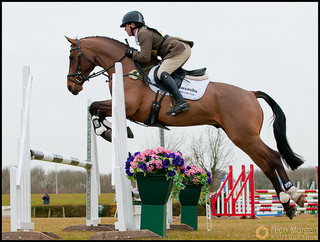
small__4458883343Hunter classes focus on the ease and style of the horse and rider as they go over jumps that are similar to what they might face on a hunt field. Hunters move with long, low, ground-covering strides and are very calm and collected. The rider almost looks like a passenger with the horse just casually floating over the fences. But the hunter must have perfect form as it jumps—knees up and forelegs parallel to the ground, legs even and tucked, and a graceful bascule (curved shaped). Style is all important. Besides way of going, this also includes appropriate tack (saddle, bridle, and martingale), braided manes and sometimes tails too, polished hooves, and the rider in conservative attire.

Hunter video:  http://www.youtube.com/watch?v=cgXm9eR0lb0

There are different tysmall__4630636060pes of hunter classes and a couple don’t include fences. Flat classes, often called hunter under saddle or hunter hack, are judged on the horse’s gaits, way of going and suitability. In-hand or model classes judge the horse’s conformation and gaits. In these the horse is led and has no saddle.

Jumper classes are very different from hunters. The focus is on clearing the jumps in the time allotted. Style, looks, attitude—none of that matters. In a hunter class, your horse may clear all the jumps but unless he does it in an easy, stylish manner with exactly the right striding and take off, he may still not score well. It depends on the subjective evaluation of the judge(s). In a jumping class, numbers tell the story. How many jumps cleared, how many faults from refusals or knockdowns, how many time faults—these are what determine the results.

small__9633348424Instead of natural looking jumps, jumpers are faced with colorful and sometimes quite outlandish obstacles, which can be scary or confusing for the horses but fun for the audience. You can see some of the most dramatic at the Olympics. Not only are the courses unusual, they are also more difficult and technical. These require bold, powerful, fast horses that are also accurate and balanced. Faced with a high fence a horse naturally speeds up. In contrast to the relaxed, laid back hunters, jumpers charge their jumps and often look barely under control. In speed classes, the audience often has their hearts in their throats.

Jumping video: http://www.youtube.com/watch?v=osAgyQtXWto

If you have the chance, go to a horse show that features hunters and/or jumpers. You’ll see some marvelously skilled athletes and have a great time.

************

High jump:  photo credit: <a href=”http://www.flickr.com/photos/thowra/515302767/”>Thowra_uk</a&gt; via <a href=”http://photopin.com”>photopin</a&gt; <a href=”http://creativecommons.org/licenses/by/2.0/”>cc</a&gt;
Hunter photo credit: <a href=”http://www.flickr.com/photos/nico/4458883343/”>Nico&#8230;.</a> via <a href=”http://photopin.com”>photopin</a&gt; <a href=”http://creativecommons.org/licenses/by-nc-nd/2.0/”>cc</a&gt;
In hand:  photo credit: <a href=”http://www.flickr.com/photos/fivefurlongs/4630636060/”>Five Furlongs</a> via <a href=”http://photopin.com”>photopin</a&gt; <a href=”http://creativecommons.org/licenses/by-nd/2.0/”>cc</a&gt;
Zebras:  photo credit: <a href=”http://www.flickr.com/photos/rpmarks/9633348424/”>R~P~M</a&gt; via <a href=”http://photopin.com”>photopin</a&gt; <a href=”http://creativecommons.org/licenses/by-nc-nd/2.0/”>cc</a&gt;
 

Categories: animals, Horses, hunting, Jumping, Olympics, ponies, riding, Show jumping, Thoroughbreds, Uncategorized | Tags: , , , | 7 Comments

Another Snippet

.

I’m back again with another small piece. Be sure to catch all the other snippets posted by the many talented authors via Snippet Sunday and Weekend Writing Warriors.

.

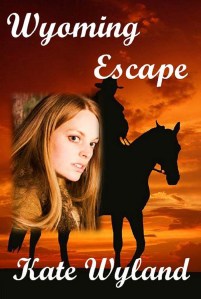
Here’s a following bit from the second chapter of Wyoming Escape.  Let me know what you think.

.

Wyoming Cover - 1600

One dead body is frightening enough. A second one, plus a dirty cop, sends chef Mikela Richards fleeing for her life. She hides on a Wyoming Dude ranch, but her attraction to an on-leave Marine threatens her fragile feeling of safety.

******.

Hiding her shaking hands under the table, Mikela offered a tentative smile. “I’m fine–just not good with loud noises.” Damn, when would she get over jumping at the slightest racket? How long before the memories of dead men stopped haunting her? She took a deep breath and willed her trembling to quiet.

Once she was sure she wouldn’t spill anything, she sipped at her cup and glanced around the small coffee shop. Not much to look at. Whoever was manning the stove knew their stuff, though. The scrambled eggs passing her table were fragrant with herbs and the coffee was the best she’d tasted in a week.

 
Categories: Cowboys, Dude ranches, Mystery, nature, Romantic suspense, suspense, Uncategorized, Western romance, writing, Wyoming | Tags: , , , , , , , | 26 Comments

My Therapist Barks

.

GenieGabrielPhoto600Today my guest is Genene Valleau, writing as Genie Gabriel. Genie is an optimist whose rose-colored glasses have bent frames and cracked lenses. She writes about people who find courage and integrity in the darkest times of their lives, who rescue stray dogs and kittens, who find a person they would willingly give their lives for, and who make their little corners of the world a better place.

FREE BOOKS!
Genene is offering a free PDF copy of her most recent book, St. Batsy and the Time Machine, to 5 commenters!

******

Raz150x174Love unconditionally. Dream big. Play with great seriousness. Bark at strangers and skateboards.

These are some of the lessons my dogs have come to teach me. I’m working on the first three, but think I’ll leave the barking to my herd of doggies.

Fur against my face and the soft smell of a dog curled protectively around me existed before my first memories of this life. My mom used to tell stories of me as a toddler, sleeping with my head pillowed on our Collie’s belly.

I grew up on a farm, and we always had a dog. I wanted a horse too, but was in high school before my dad gave in to my begging to have one. Do you think you can become addicted to the smell of a horse? To this day, even the memory of that sweet aroma totally relaxes me.

However, after graduation, I moved to the city to claim a job and my own life. A back yard isn’t the best place for a horse, but I could indulge my love for dogs. A small, mixed breed Lady became the first beloved companion in my adult life. She tried to teach me to choose my relationships wisely. Ah, if only I had listened to her. An ill-fitting marriage ending in divorce turned my focus back to dogs as companions.

Batman150x194I was almost forty years old when I discovered the joy of shelter dogs and living with more than one canine. The more time I spent with dogs, the more I learned.

When I began writing, dogs naturally turned up in my stories. My first novel, published as The Rock Star, featured a dog who turns on the coffee maker for his mistress and has an attitude similar to my first shelter dog, a Border Collie mix.

Two of my romantic comedy novellas also feature dogs inspired by canines who have shared my life. My latest book to be released in print, St. Batzy & the Time Machine, features a terrier with a penchant for misadventures. His attitude is quite similar to my own terrier, who views fences as something to try to dig under, jump over, or wiggle through.

Dogs will definitely continue to be strong characters in my writing. In fact, I will soon be publishing a book about my journey with dogs and how they have guided me through traumas and brought me face to face with sometimes uncomfortable truths. However, underlying all their actions is pure, unconditional love and the support to make our most precious dreams a reality.

Oh yes, and to play–no barking needed on my part!

*****************

StBatzyCoverFront200An eccentric inventor is determined to reclaim his wayward time machine and save his beloved wife from her latest misadventure. If only they can travel safely past the black hole…
 

******************

When they were seated, he told Dorinda the story of how he and Maddie had met. How he loved her from the first moment, and never thought a woman as bold and brave would ever love him in return. “My Maddie still goes on grand adventures to change the world. I worry about her, but I’m so proud of her.”

Dorinda remained quiet for a few moments after Horace stopped talking, then said softly. “I would like to live in a world where there is plenty of food and women are allowed to follow their passions.”

In the next breath, she pushed out a sigh and stood. “’It is not productive to grumble about what cannot be. I will leave you to rest, and I have much to think about. Thank you for a look into the future. You have given me hope.”

“Let me accompany you back to the village.” Horace also rose.

However, Dorinda shook her head. “As an elfenchaun, I’ll be quite safe with the creatures of the forest.”

Still, Horace watched Dorinda from the entryway of the time machine until the trail of shimmering green faded into the night. Elfenchaun or not, he worried about the delicate creature who had shown him such kindness. Would she truly be forced to give up the life of relative freedom she had known and marry a man who would control her every move? He would not want to smother his Maddie’s bold spirit, even if it cost him days of worry when she was gone.

All the next day, Horace toiled under the watchful eye of Dorinda’s grandfather. As the light of day faded into twilight, the man shook Horace’s hand and presented him with a curved piece of metal to repair the time machine.

Though exhaustion threatened, the desire to return to the year 2011 and rescue his Maddie gave Horace the energy to drag the metal back through the forest and replace the damaged panel of the time machine.

As Horace gathered his tools and placed them back inside the time machine, he looked forward to seeing Maddie again. He walked the short distance to a small stream and splashed cool water over his face, any tiredness dripping away with the water that ran down his skin. Soon he would see his Maddie!

The short distance back to the time machine took only a few moments, yet Horace knew something was not as he left it. His steps slowed and he looked cautiously around, listening carefully for any clue to what might have happened in the moments he had been gone.

A moan near his feet was all that prevented him from stepping on a tiny crumpled body on the ground. “Dorinda?”

He bent over the little elfenchaun, stunned by the pallor of her face and the broken remnants of her iridescent wings. “What happened?”

“Over here! I saw her fly this way.” Strident shouts tore the peace of the night to tatters as lanterns bobbed closer and closer.

Adrenaline surged through Horace. As carefully as possible, he lifted Dorinda and carried her into the time machine. Laying her on a pad next to Batzy, Horace locked the door panel and started the sequence for the reactor. “Clement, can you give us a boost to get us out of here?”

“Thank the heavens!” Maddie appeared on the monitor beside Horace’s cousin.

Clement’s fingers flew over the computer keyboard. “What took you so long to make repairs?”

************

Print version of St. Batzy plus Genie’s other books on:  http://tinyurl.com/mozwtzd

ebook version of St. Batzy also available at Rogue Phoenix Press:  http://tinyurl.com/mwzuj4v

Categories: animals, dogs, healing, Horses, Paranormal, Relationships, romance, Romantic suspense, suspense, Time travel, Uncategorized | Tags: , , , , | 13 Comments

I is for Horse Illnesses

.

small_185495090For such large, athletic animals domestic horses are surprisingly fragile, due to the artificial environment man puts them in. Wild horses are sturdy, hardy animals—smart, wily and able to take care of themselves. They graze all day, move constantly and only the healthiest survive and reproduce. They are also relatively small, not particularly pretty and very strong-willed.

Consequently, when man decided horses were good for more than providing meat and milk, he began breeding them for specific traits. Good temperament, large size, speed and beauty were some of the prized characteristics. Over the millennia horses morphed into creatures that often would have a hard time surviving in the wild and even have problems surviving in man’s care. The desire to win races has resulted in many Thoroughbreds being very fast but having weak feet and overly sensitive emotions. Show ring “fashions” have encouraged huge bodies with slim, tiny legs and feet that cannot stay sound for the long run. And, of course, miniature horses, as cute as they are, would be hard pressed to survive on their own.

small__598978125Add to that, being confined twenty-three hours a day in a small stall, being fed large amounts of hay, instead of eating grass, and being asked to do intense work instead of moving casually, and today’s horses develop problems that they wouldn’t encounter in the wild.

One of the most common and deadly problems is a result of how they are kept and fed. The horse’s stomach is designed to digest small portions of food all day long. While some horses are kept in large pastures where they can graze naturally, this kind of open land is disappearing and most horses, by necessity, live in confined areas, either stalls or paddocks. Then they are fed calorie-dense hay and often grain too, usually twice a day because that fits best with human schedules. As a result their digestive systems can be easily upset and they can colic.

Colic is basically a painful bellyache that can be relatively easy to treat or can develop into something deadly. It is the most common cause of death in horses. Bad food, dirty water, parasites, lack of exercise, a sudden change in the weather are some of the many things that can provoke a colic attack. In most cases, the problem can be solved by a visit from the vet. Sometimes surgery is required (a very expensive proposition) and other times the only thing to do is to put the suffering animal down. Good management is vital to keeping horses healthy and happy.

freeimage-144227Another illness connected to food and care is known as laminitis, a very painful condition that affects the hooves. The equine digestive system cannot handle large amounts of concentrated, high-carb food. If a horse should get loose and into the grain barrel or pig out on high-sugar Spring grass, this can trigger an inflammatory response which destroys the tissues in its hooves that hold the boney structures in place. Depending on the extent of the damage, the result can be devastating. Conditions such as Cushings Disease or Metabolic Syndrome can make horses susceptible to laminitis problems too.

As odd as it might seem, horses have many of the same problems that humans do. They can have allergies, COPD, arthritis, thyroid dysfunctions, bursitis and a host of other disorders. And they are treated with many of the same medicines. I used to give my daughter’s mare powdered Synthroid for her low thyroid and albuterol for her breathing problems. Horses with stomach ulcers often get Tagamet.

Of course, wild horses are unlikely to have ulcers or allergies or a lot of the other problems. These tend to be the result of living with man and doing the work he asks of them. So it behooves us to be aware of the consequences and do our best to take good care of our equine friends. Today, because of advances in understanding and veterinary care, horses are living and working into their thirties. Something very rare in previous times.

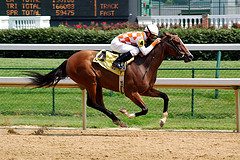
Race horse photo: http://tinyurl.com/mtxc7uo
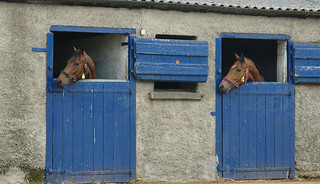
Stable photo: http://tinyurl.com/lu8ysme
Categories: horse care, Horses, nature, outdoors, ponies, riding, stables, Thoroughbreds | Tags: , , , | 10 Comments

Hunting—with Horses—not Guns

.

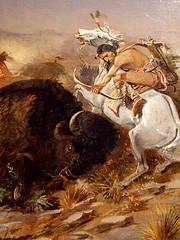
small_210455752Man has used horses for many tasks throughout history—pulling plows, wagons and chariots, carrying loads on their backs, traveling long distances, and even hunting other animals. In fact hunting was probably one of the first uses of our equine companions. Their speed increased the chances of catching the faster prey and allowed the hunters to cover more ground. Almost everyone has seen the exciting buffalo hunt in the movie Dances With Wolves that vividly illustrated their importance to the American Plains Indians.

Riding in a hunt was dangerous and exciting. Who knew what might happen. A rider could get knocked off, a horse could trip and fall, or a prey such as a wild boar or bear could turn the tables and attack. It was a great way for warriors to hone their skills and horsemanship. As a result, hunting became a favorite pastime of the noble and wealthy.

Of course the basic purpose was to supply meat for the table or to get rid of unwanted intruders that threasmall__6465633813tened crops and livestock. One such pest was the wily fox, which found farmyard poultry easy pickings. While farmers could use dogs to track, the foxes were smart enough to backtrack and confuse their trails and lose their pursuers with relative ease. At that point a human was needed to redirect the hounds, and only someone on horseback could keep up with the chase. (Foxes can run up to thirty miles an hour.) As forests were cut down to create arable land, the number of deer decreased, causing enthusiastic hunters to switch to chasing foxes instead, particularly in Great Britain.

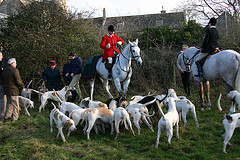
A whole culture developed around fox hunting in England, dictating what to wear, who could be part of a hunt, where you rode in the group and many other niceties. The most important member is the Master of the Hunt, who runs the whole show. He’s responsible for the care of the hounds, organizing the hunt and supervising all hired personnel. Often he also serves as the Huntsman, the one who controls the hounds during the chase. His assistants are the Whippers-In and they help make sure the hounds don’t go off chasismall_3137633691ng some other animal rather than the fox. Traditionally, male members of the hunt could wear red coats (often known as “pinks” for some unknown reason), while women wore black or navy coats with colored collars. Only members who have been “honored” by the Master are allowed to wear these colors. Everyone else wears black or navy.

While the original idea of fox hunting was a way to help eradicate a notorious pest, that rational is less valid today. In England, hunting and killing a real fox has now been outlawed. In the US, the emphasis has always been on the chase and foxes were rarely killed. Nowadays instead of pursuing real animals, most often the hounds and riders follow a scent trail laid down by someone dragging a bag smelling of fox. The “first field” of riders follows the trail exactly, going over all the obstacles. The “second field,” sometimes called Hilltoppers, takes an easier route, going through rather than over gates, and going around other obstacles, and sometimes stopping to watch the other riders from atop a hill.

Running full bore across uneven terrain, jumping ditches, hedges, streams, fences and other obstructions is a thrill that’s hard to beat. While the original rational for fox hunting may be long gone, the appeal of the chase will never fade.

****

Buffalo photo credit: http://tinyurl.com/l67cwka
Old print photo credit: http://tinyurl.com/mxc2fpx
Fox hunt photo credit:  http://tinyurl.com/m8mrjkm
Categories: dogs, fox hunting, Horses, hounds, hunting, Uncategorized | Tags: , , , , , , | 3 Comments

Sheep and Writing Stories

.

borrowed chickens.

Please welcome my guest KB Inglee. KB writes historical short stories which have appeared in several print anthologies.  Her story “Weavers Trade” placed second in Bethlehem Writers Roundtable. Many of her story ideas come from her job as historical interpreter at two living history museums near her Delaware home. And sheep are often her inspiration.

******

When I was 7 my sister was given riding lessons as a Christmas present. How can that be fair when I was the one who devoured every horse book in the library and turned our back yard apple tree into a whole stable of horses? The first story I wrote was about a horse named Star.

Imagine my surprise when I realized my first novel had not one single animal in it. It was set in a time when horses were common forms of transportation. I didn’t have so much as a cat in the kitchen.

OLYMPUS DIGITAL CAMERAIf you are going to write historicals, you need to do the things your characters do. I visited a living history museum near my home and discovered a flock of heritage sheep. I learned to give tours, tell the story of the family that lived there. My first published work (Farmer’s Daughter, Miller’s Son) is a kid’s look at the time period. I hand stitched a set of appropriate clothing. All the while I was longing to get my hands on the sheep. I wanted to do any animal type work my characters might have done: drive oxen, plow with horses, and raise chickens. I don’t remember when I was first invited to work with the sheep, probably I got to feed them when the regular shepherds were out of town. In ten years I worked myself up to head shepherd.

I was of an age where I was happy to move from 1200 pound animals with heavy feet with iron shoes to something smaller which didn’t break bones when it stood on my toes. I have been present at the birth of lambs, had had to put down old and sick animals that have been my friends for years. I can tell you how the industrial revolution changed agriculture and how the market value of sheep has changed over the years. I can process wool from the back of the sheep to the back of the person. I even butchered a sheep.

author vs sheepIf I have a muse at all, it is these animals. Like my protagonist they appear gentle but they will happily knock you down and walk over you if you are in the way. Like my protagonist they are patient and can stand around for hours waiting. If you have food, then they will push and shove to get to it, just as my protagonist will to find the answer to a problem.

If I am stuck for an idea or the way out of a plot problem, all I have to do is stand among the sheep. I can dig my fingers deep into the wool, listen to them breathe, watch them interact with each other and with me and the visitors. It may be a form of meditation.

There are still no animals in my narratives, but I have a whole flock involved in the writing.

*****

Here are some of KB’s stories, available on Amazon.

Joseph's captivity.

“Joseph’s Captivity”, Untreed Reads, 2012
A grumpy Joseph finds himself exiled, not to Egypt, but to an island
off the coast of Maine in the early colonial period.

Fish Nets.

“Netted”, Fish Nets, Wildside Press, 2013
A pile of string helps uncover a murderer

Magic Bullet.

“The Magic Bullet“, Death Knell V, Infinity Press, 2013
An article in French and an old gun provide the clues to solve a series of armed robberies.

Categories: animals, anthologies, history, living history, Mystery, outdoors, sheep, Short story, suspense, Uncategorized, writing | Tags: , , , , , | 15 Comments

Rack On!

.

Walk, trot, canter are the three basic gaits all horses have. What about slow gait, rack, running walk, single foot, tölt, fox trot, or the paso largo? These are a few of the additional gaits some breeds of horses can do. Where did all these additional gaits come from and why do they exist?

small__5787205489The simple answer is comfort. For most of human history people traveled by foot or by horse. Carts and carriages were heavy, slow and not particularly comfortable. If you wanted to get somewhere quickly, you rode horseback. However, a horse’s walk is relatively slow, the trot is uncomfortable and the canter can only be sustained for short periods. Also, it was common for women to ride sideways behind a rider, especially if they didn’t know how to ride. This put them over the most active part of the horse and restricted them to a walk. Any other gait would make it difficult to stay on.

So what was needed was a horse with a fast but smooth gait that would let you ride all day in relative ease and wouldn’t bounce you off its rump. Some horses had natural variations on the walk that allowed them to move this way. Amblers, as they were commonly known, were highly valued until about the 18th century when other forms of transportation arose.

The amble in all its permutations is a four-beat gait where at least one foot remains on the ground at all times (thanks Sue), providing a smooth, easy-to-sit ride. With three gaited horses, their backs move and require the rider to move with them. Gaited horses keep their backs relatively still and just move their legs. This provides a silky smooth ride that requires little of the rider. A classic demonstration is to have the rider carry an old fashioned, shallow glass of champagne in his hand or to put the champagne glass on the horse’s rump. A good horse won’t spill a drop.Silvano Taipe show horse

Innumerable variations of the amble developed over the centuries and in different parts of the world. Hispanic cultures tend to like flashy, showy horses and the Peruvian Paso and Paso Fino of South America reflect that. They have very fast, showy gaits that look quite unusual to American eyes. The Icelandic Pony also attracts attention for its small size and speedy ground-covering tölt.

The early settlers of the United States also valued comfortable horses and developed their own versions. The Tennessee Walking Horse, with its running walk, was bred to give plantation owners a smooth, all-day ride while they supervised their vast holdings. The Missouri Fox Trotter, Rocky Mountain Horse, Spotted Saddle Horse, and Kentucky Mountain Horse are variations on the same theme.

small_9680085853The American Saddlebred was first bred in colonial times as a high-stepping but smooth ride. Then it was further refined in Kentucky and became a popular military mount during the Civil War. Known as the peacock of the horse world, the Saddlebred can be either three-gaited or five-gaited. Its two extras are the slow gait and the rack. The rack is done at speed and is exciting and crowd pleasing. Rack on! is the command.

Here is a link to a site that has short videos of many of the horses I talked about. They need to be seen in action to be understood. http://majesticrider.com/id100.html

Since the previous site didn’t include the Saddlebred, here’s one that does. http://www.bing.com/videos/search?q=American+Saddlebred&FORM=VIRE2#view=detail&mid=1C43754AAF7CEA68E44C1C43754AAF7CEA68E44C

**********************

Lady: photo credit: <a href=”http://www.flickr.com/photos/marionzetta/5787205489/”>Marionzetta</a&gt; via <a href=”http://photopin.com”>photopin</a&gt; <a href=”http://creativecommons.org/licenses/by-nc-sa/2.0/”>cc</a&gt;
Saddlebred:  photo credit: <a href=”http://www.flickr.com/photos/desertnightcreations/9680085853/”>Heather Moreton-Abounader Photography</a> via <a href=”http://photopin.com”>photopin</a&gt; <a href=”http://creativecommons.org/licenses/by-nc/2.0/”>cc</a&gt;
Categories: gaited horses, history, Horses, Kentucky, riding, Trail riding, Uncategorized | Tags: , , | 15 Comments

The Sensitive Extrovert

Wow! WPRG Reviewer's Choice nominee flathat a surprise!

My books, WYOMING ESCAPE and FOREWARNING, have been nominated for the PRG Reviewer’s Choice Award for “Best Mystery/Thriller/Suspense.” Voting is open from through Sun, Jan 12.

I’d really appreciate your support and vote. Unfortunately the books are competing against each other, so I hope you’ll choose Forewarning. You’ll have to page down a ways to get to the Mystery/Suspense listing. If you click on either cover image, you’ll be able to see the reviews for both books.  And you need to register on the site in order to vote.
http://www.paranormalromanceguild.com/2013reviewerschoice.htm

******

I’m still catching up from the holidays, so I’m recycling an older post about horse personalities that I hope you will enjoy.

Previously I talked about the Extrovert Thinker as typified by my horse Star. Today, I’d like to discuss the Extrovert Reactor.

First, a quick note: These personality types are on a continuum, of course. Some are more extroverted than others, some are less reactive. Some can change—become less introverted or more of a thinker. But their basic type remains and influences their actions.

Portia at 29

Portia at 29

My mare Portia, a grey Anglo-Arab (half Thoroughbred and half Arabian), was a typical Extrovert Reactor. She was very sensitive to stimuli and hyper-aware of her environment. Even at age twenty-nine and retired, she could be a challenge and needed an experienced handler. Not that she’d ever deliberately hurt someone, she just tended to react first and think later.

She also really enjoyed life. She loved to play and would try her best to please. She’d yell a greeting when she saw me and come running up to the gate eager for a treat or an outing. In the show ring or a parade, when she “turned on” all eyes were on her. She also used to fly down a new trail with her incredible walk, eager to see what was around the next corner. Even though she could be a pain in the butt, her exuberance was a lot of fun.

When I first got her as a seven year-old, she was ready to spin and bolt at the slightest provocation—a rock that looked funny, a horse scratching it’s ear with a hind leg, a COW on the trail! She soon learned bolting wasn’t acceptable behavior so she tried others. Like teleporting half way across the arena or jittering in place or jumping straight up. I eventually discovered that part of the reason for her reactivity was because she was in pain. She needed chiropractic care (just starting with horses at that time and not widely accepted) and a correctly fitted saddle (which proved to be almost impossible to find). Once those problems were solved, she settled down a lot.

But she still retained her quirky personality. One time we hung a bright pink piñata in a tree near the pasture and she and my daughter’s horse decided that it was a decidedly SCARY thing. They came up close to the fence, took a look, then snorted and high-tailed it back to the barn. Duchess stayed there, but Portia couldn’t resist. She’d dance back up to the fence and watch big-eyed as one of kids swung at the colorful unicorn. Then she’d take off for the other end. A few minutes later, she was back, waiting to be “scared” again. I swear she was disappointed when the thing finally broke and everyone went away.

Her playfulness and sensitivity made her a delight to train. She was eager to learn new things and would try her hardest to do what I asked. Of course, this meant I had to be quite careful  with my corrections so I wouldn’t discourage her. In general, she’s always required a very light hand. As a result, I got a horse responsive to the slightest cue and that just about read my mind.

Riding her was never dull. One time we were exploring in the mountains and I twisted around in the saddle to get a map out of the saddlebag behind me. Just then a pair of fawns exploded across the trail, directly in front of us. Portia spun aside–out from under me because of the way I was turned. I ended up hanging off her, one hand somehow on her bridle, one hand on the breast collar, one foot still in a stirrup under her belly and the other still in the stirrup on top of her back. Because of how far down I was and the fact the saddle was slipping, I couldn’t get back up. Another horse might have freaked and tried to get rid of me, but Portia stood perfectly still and waited for me to work myself loose of the stirrups and drop to the ground. I really couldn’t blame her for dodging  the fawns and I certainly appreciated her being sensible.

Obviously a sensitive, reactive personality is not appropriate for an inexperienced horse person. This type needs a calm, confident rider who doesn’t get upset by spooks and silliness. But if you know what you are doing and have a light touch, a extrovert-reactor can be great fun.

I lost Portia this summer at age 30. I really miss my delightful “brat child.”

Categories: Books, horse personalities, Horses, nature, outdoors, riding, training horses, Uncategorized | Tags: , , , , , | 3 Comments

A Christmas Fling

Beth-Barany_360by270-cropped.

My guest today is Beth Barany, author of a brand new Christmas novella, A Christmas Fling. Based in Oakland, California, Beth writes magical tales of romance and adventure.  She’s also a writing coach, helping other writers realize their dreams.

*****

Kate, Thanks for having me on your blog to share about my new romance, A Christmas Fling, a sweet paranormal romance novella. It’s the tale of a Santa’s Elf, a hard-working financial analyst, and a Bernese Mountain Dog named Sally.

Dahlia, a Santa’s Elf, has 21 days left before Christmas to create the best toy in the world without using magic or revealing her true identity. Stuck on how to complete the prototype, and working as a temp in San Francisco’s Financial district with no time for love, will her innocent Christmas fling get her unstuck, or will she turn her back on her beloved career for her heart?

 Liam, an up-and-coming financial analyst, swore off women after getting dumped by the love of his life. He just found out his ex is going to the company Christmas party with his rival Michael Hendricks. Up for promotion against Hendricks, Liam has to win the favor of his boss. His best bet is to invite the vivacious secretary Dahlia to the party. Will Dahlia be a welcome distraction, or will she turn his life upside down?

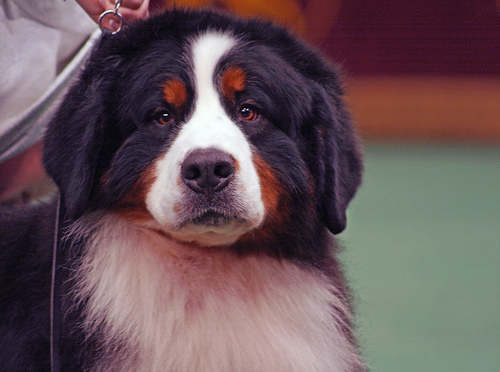
Bernese Mountain Dog by Lori Branham--CreativeCommonsLicense2.0When I was creating my story, I knew I wanted to include a dog and specifically a Bernese Mountain dog. I see these dogs all the time in my Oakland neighborhood. They look so friendly and huggable I thought one would be perfect in my story of workaholic man learning how to have love in his life.

Liam has to take care of Sally for his roommate Josh, who is away at a conference. When Dahlia pets Sally, Liam is surprised to realize he wants Dahlia’s affection, even though he’s sworn off love.

Kitty-black_Leo-Tabby-cropCurrently I don’t own a dog. I just have two lovely and rambunctious cats. I did grow up with dogs and cats and a pet rat, and I even had a Hermit crab for a short time. I think pets bring joy and love into our lives. I’ve seen pets diffuse a difficult situation and also bring laughter where there wasn’t any. When I was going through a rough patch in my life, we brought Kitty into our lives. She gave me something to care about other than myself. A few years later, we adopted a rescue cat, Leo, as a companion for Kitty. It’s so much fun to watch them play together and learn from each other.

Readers, Enjoy A Christmas Fling. Here’s an excerpt! Thanks for stopping by!

*****

EXCERPT

December 1, Oakland, CA

 A CHRISTMAS FLING by Beth Barany-400x600Dahlia strolled through the small neighborhood park. It was great fun to think about how the children would enjoy her toy once she was done with it, but she had to complete it first. She only had twenty-two days to fix whatever was wrong with it before returning home. She’d gone over her designs and schematics and taken it apart and put it back together a dozen times, but it still wouldn’t work.

Dahlia left the park and headed down the street toward the detached studio she rented on Miles Avenue.

A dog bark had her look up just in time to almost but not quite avoid getting tangled up in a long leash. A man with the warmest brown eyes she’d ever seen gazed down at her, a half smile on his face.

She smiled back startled out of her daydreaming, but not before she noticed his endearing dimple on one side of his mouth.

She said, “Sorry, I didn’t see you. Thank goodness for your dog. Oh, she looks like a Husky.”

Dahlia shifted her bag to one hip, so she could bend down and pet the dog.

The dog wagged her tail.

Dahlia said, “You must feed her really well. Her coat is so soft and luscious.”

“She’s a Bernese Mountain Dog. Sally. My roommate’s.”

His voice was deep. She had to look up to smile into his deep brown eyes. He was a whole head taller than she was. Almost two meters. She translated into American measurements. Six foot three or something.

“My uncle, well one of my uncles has one—that he uses for work. But I hardly see him because he lives—” She paused. “I’m prattling, aren’t I?”

“Yes, you are, but I like listening to your accent. Scottish?”

“Yes, wow, you guessed correctly. Most people here can’t do that. Yeah, we’re from Scotland, but it’s been a few generations.” She couldn’t very well tell him how Santa’s elves lived a very long time. It had only been her grandparents that had immigrated with Uncle, known as Santa to most, and some neighbors to set up the North Pole.

“So, you’re in school here?” He waved off toward what she knew was the art college a few blocks away.

“No. I’m here on an independent research project for a few more weeks.”

“So you’re from—”

“Alaska. Well, near Alaska, anyway. I—I best be going,” she interrupted and gestured to her bag of goodies. She shifted from foot to foot on the corner of Miles and Clifton Streets, still tangled up in the Bernese’s leash. “Gifts to wrap. For the kids. Big project.” She gulped and held out her hand. “I’m Dahlia, by the way. Dahlia MacMillian.”

With a half-smile, he shook her offered hand. His grip was firm and strong. “Liam. Nice to meet you, Dahlia MacMillian.” He led the dog around her, slowly untangling the leash.

How he moved with grace and power, even in his simple gestures. He was tall, lean and muscular, broad shoulders identifiable even in his sweatshirt with the UC Berkeley name and logo on it.

“There we go, Sally,” Liam said, his voice a rumbling, soothing cascade.

Sally licked Dahlia’s hand, bringing her out of her staring. She gulped and felt the heat of a blush creep up her neck and onto her cheeks. Dahlia stroked the soft fur to cover her embarrassment. It had been a long time since she’d felt attracted to anyone. Everyone she’d dated at the Pole was so familiar to her, and mostly related. She didn’t have time for a distraction.

She looked up when she heard Liam chuckling. He was shaking his head.

“What?” She couldn’t help but ask.

He shrugged. “I guess I should run into girls more often with my roommate’s dog. I didn’t realize it could be such a pleasant experience.”

“You must not walk her very often then.” Oh my, she was flirting. The Elf boys back home never brought that out of her. She felt her pale skin flush. Och, yes, this was a man, she thought. “Thank you, then. For the pleasant experience. And the untangling.”

“You’re welcome.” Liam said to her, smiling, that one dimple showing again. Then he spoke to the dog. “Come on Sally. Let’s finish your walk, so we can go watch the game.”

Dahlia waved good-bye and turned to go down the street and head for her apartment. But first she had to watch Liam walk away. He fit nicely into his jeans. For a moment, a pang of wistfulness washed through her. She shook her. She had other things to focus on, like completing her toy on time so she could get her Master Elf badge, and even win the Grand Prize.

She was sure she’d be able to make progress on her toy tonight. Maybe it was something about meeting a happy dog and tall brown-eyed man that made her feel hopeful. Yes, she would get her toy done in time.

******

About Beth Barany

In her off hours, Beth enjoys capoeira (a Brazilian martial art that combines elements of dance, acrobatics and music), traveling, and watching movies with her husband, bestselling author Ezra Barany, and playing with their two cats, Kitty and Leo.

Where to Find A Christmas Fling

A Christmas Fling on Amazon:http://amzn.to/18ELyiY

A Christmas Fling on Goodreads:http://bit.ly/1bytk64

Photo: A Bernese Mountain Dog by Lori Branham – Creative Commons License
Categories: Bernese Mountain dog, Books, Cats, Christmas, dogs, Dogs and cats, fantasy, Love, Paranormal, romance, Santa's elf, Santa's workshop, toys, Uncategorized | Tags: , , , , , , , , | 3 Comments

Gaits – Not Gates

small_185495090

Today I’m going to talk about how horses move—their gaits. Contrary to what the movies usually show, horses do more than walk or run flat out. In fact the most commonly used gait of all, the trot, is only seen if they are pulling carriages. So what is the reality?

You’re probably familiar with the horse’s four natural gaits—walk, trot, canter and gallop. But did you know that some horses have six or more gaits? I’ll talk about the basics first.

small_10020981376The walk is a slow four-beat movement. First a rear foot moves, followed by the front foot on the same side, then other rear foot followed by its front. With this pattern three feet are always on the ground providing a smooth, easy ride. Horses vary greatly in size, shape and energy, but an average walk is about four miles per hour. Some have much faster walks, in the six mph range.

A good rider knows to keep his/her body still and quiet so as not to disturb the horse’s balance. If you allow yourself to move in the saddle, the horse has to constantly deal with a shifting weight that can interfere with his equilibrium. Therefore, it’s important to keep your upper body still—but not rigid. Your pelvis needs to move with the movement of the horse’s body. At the walk, this means allowing each side of your pelvis to move forward and back independently as first one rear leg steps forward and then the other. At a normal, casual walk this is usually no problem. At a speed walk, it’s surprising how tiring that can be.

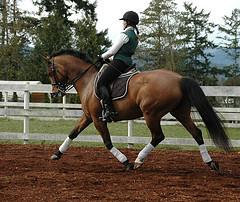
The trot is a faster two-beat gait where opposite pairs of legs move at the same time. small_369623604As each pair goes forward, the horse’s back drops a bit, which causes the rider to feel a jar when the feet land and the back rises again. Learning to ride a trot comfortably is a beginner rider’s hardest task. The easiest way is to learn to post, which means rising out of the saddle and sitting back down in rhythm with the gait. Some horses do a slow jog that has very little bounce and is much easier to sit, but it doesn’t cover a lot of ground. If you want to go a long distance fairly fast, you’ll be doing most of it at a trot. This applies whether you are riding or being pulled in a carriage or coach. The trot is the “working” gait for going places. Something to keep in mind if you write about people traveling distances.

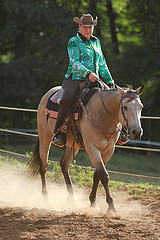
small_2431865552The horse’s third gait has a couple of names. If you are riding English style it’s a canter, but it’s a lope when you ride Western. Either way, the canter is a three-beat leaping gait with a moment of suspension, but is much smoother to ride than the trot. Here the rider needs to let her whole pelvis move forward and back with the movement. The canter or lope is a controlled fast pace that allows you to cover ground quickly, for a shorter period of time.

The gallop or full out run is the fourth standard gait and used for racing or fleeing a predator in the wild. It’s a four-beat, stretched out, ground-covering canter that can only be sustained for a relatively brief period of time—one to two miles. Despite what you see in the movies, horses can’t run fast for long periods. Usually the rider stands in the stirrups when galloping.

In addition to these standard gaits, there are a number of additional gaits specific to certain breeds. These horses are unusual and fun and I’ll talk about them next time.

Here’s video about gaits:

***************************************

Race photo credit: <a href=”http://www.flickr.com/photos/kubina/185495090/”>Jeff Kubina</a> via <a href=”http://photopin.com”>photopin</a&gt; <a href=”http://creativecommons.org/licenses/by-sa/2.0/”>cc</a&gt;
Horse walking photo credit: <a href=”http://www.flickr.com/photos/63942879@N05/10020981376/”>Katherine Mustafa Photography</a> via <a href=”http://photopin.com”>photopin</a&gt; <a href=”http://creativecommons.org/licenses/by/2.0/”>cc</a&gt;
Horse trotting photo credit: <a href=”http://www.flickr.com/photos/nikkis_pikkis/369623604/”>nikki_tate</a&gt; via <a href=”http://photopin.com”>photopin</a&gt; <a href=”http://creativecommons.org/licenses/by-sa/2.0/”>cc</a&gt;
Horse cantering
Categories: dressage, Horses, nature, outdoors, Racing, riding, Thoroughbreds, training horses, Uncategorized | Tags: , , , , , | 6 Comments

Blog at WordPress.com.